Episode Transcript
[00:00:00] Speaker A: Welcome to the Gregory and Paul Show.
[00:00:02] Speaker B: Hey everyone. Paul.
[00:00:04] Speaker A: And on this show we break down the Latest in startup SaaS, AI and whatever the Internet has been debating this week. We always aim for smart takes, but hey, we end up with many, many dumb ones.
I'd like to think we'll hit on a few scorchers. And of course, we love memes way too much.
[00:00:24] Speaker B: That's right. We're streaming live on X and LinkedIn every Friday at noon that we post straight this onto YouTube.
Someday we'll get this on the podcast platforms as well. I think the plan is that we'll do that after we record around five episodes, then we'll launch on Apple, Spotify and Google.
[00:00:45] Speaker A: Yeah, I don't think Apple lets you just upload one, does it?
[00:00:48] Speaker B: No, we'll have to self host.
[00:00:50] Speaker A: Yeah, exactly.
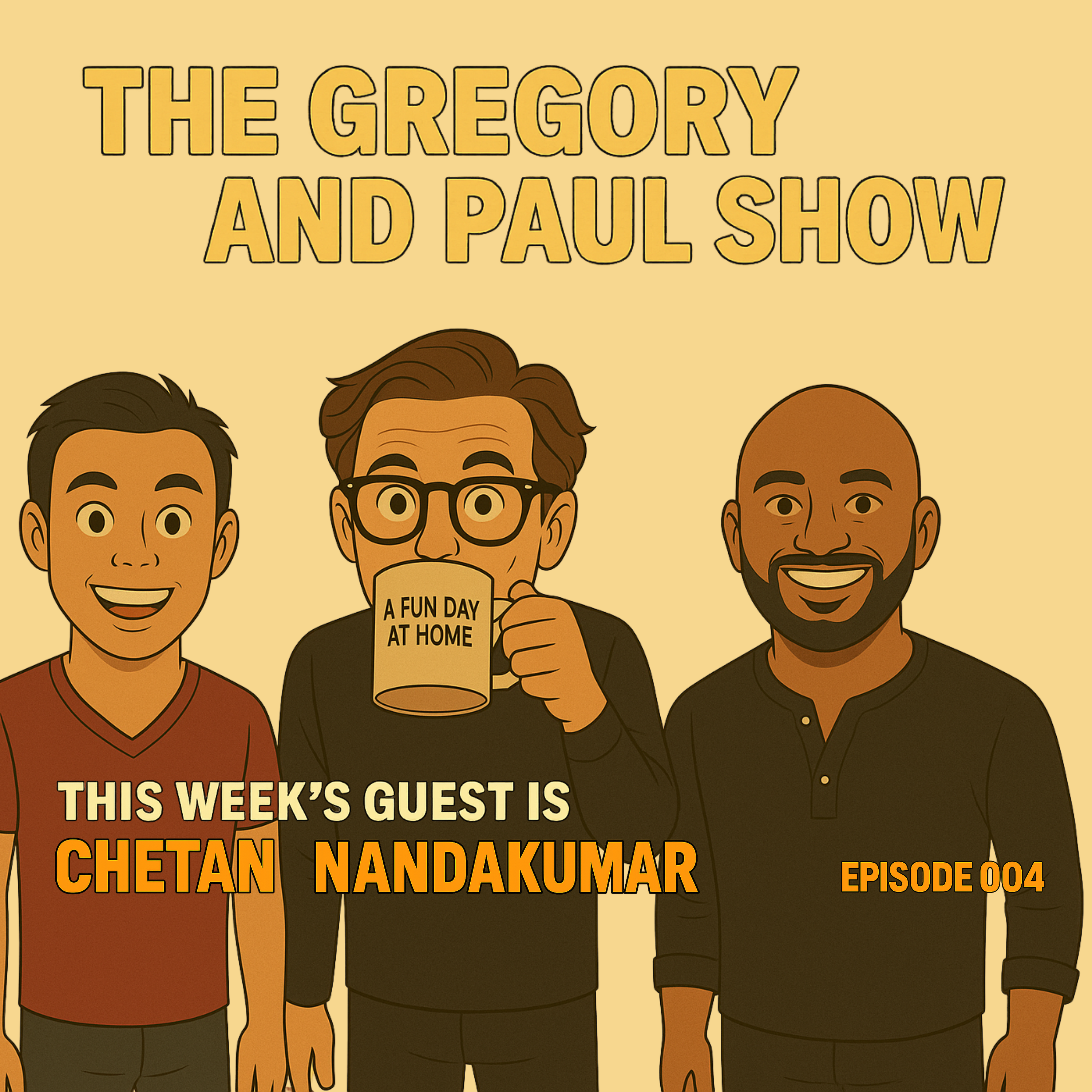
And so we have a guest, Chayton Nanda Kumar. Did I get that right?
[00:00:57] Speaker C: Yeah.
[00:00:58] Speaker A: Awesome. He's a technologist, entrepreneur educator with deep expertise in computer vision, AI coordination and decentralized systems.
A UC Berkeley graduate, earned his PhD studying the Human visual cortex and how the world used those insights. Or he uses those insights to build smart computer vision tools during your time in academia. True together one.
[00:01:27] Speaker C: Right.
[00:01:27] Speaker A: Okay, awesome.
Let me keep going. So, well, Berkeley, you co founded Modista, an AI powered platform for enhanced online apparel discovery through computer vision. Right?
[00:01:39] Speaker C: Yeah.
[00:01:40] Speaker A: Awesome. And then you took over leadership of VP of products at Jensen, building decentralized machine learning networks. And you're now CEO and founder of Forum, where you're also developing the monetized MCP protocol, which will bring programmable payments to MCP servers, fueling the AI agentic ecosystem.
[00:02:10] Speaker C: Correct. Thank you, Gregory.
[00:02:13] Speaker A: Yeah, I had to do a lot of research for that one. I was like, wow, this is quite, quite interesting. And then of course, Paul here is a huge fan of MCP servers. And so maybe we even just like kick this off and have a conversation about MCP servers and what they are and what they mean for the agentic ecosystem. Let's just start with a definition for people who are maybe as familiar with it as we are.
[00:02:43] Speaker B: Yeah.
Should one of us talk through what MCP server is? I feel like. Jen, you should.
[00:02:49] Speaker C: Sure, yeah. I can just take a brief intro to folks who are new to it. So essentially I'll say a few things. One is MCP is a way to.
The way it was sort of brought about was that folks at Anthropic realized that Claude was trained on Internet data, but didn't know anything about your data. So all the data that is nervous in your hard disk or in your databases or in your SaaS services. So MCP was essentially the original idea was to be kind of connectors. It was a protocol that allowed an LLM to be connected to data sources locally or on the Internet. And what it's going to evolve to is kind of a sort of an AI friendly API that essentially allows a service to interact or be interacted with by an LLM or an AI. So there's a bunch of really cool things that can happen when this integration is possible.
So your LLM can, let's say, go through all of your, all your data, make sense of it and then write emails for you. Right. Because if you have a Gmail integration and a database integration, so there's all these, this kind of simple sort of protocol unlocks all within the AI space.
MCP is almost turning into the HTT of AI.
[00:04:10] Speaker B: It's a really good way of putting it.
Do you think? So continue on the question. Do you feel like MCP will become the default way for agents to interact with our data?
[00:04:24] Speaker C: I think so. You know, there's a few different protocols out there. I think we definitely need a new protocol. So the protocols that we currently have were not built for agents and there's a lot of nuance in and things that we have to sort of that require something new.
And right now MCP has really kind of had such a head start, has so much adoption that I think likely it'll win out. There's a few others, A2A by Google. There's another one, I think ACP by IBM. There's a few other ones that are out there. But my guess is that given how much of a head start and MCP currently has and how much adoption has. Totally one that wins out.
[00:05:03] Speaker B: Yeah, totally. I, you know, I, I jumped on to this AI trend about a year and a half ago and a few companies has tried to use AIs to automate some tasks on the browser or you know, OpenAI has the browser mode. It's just never really made sense to me. Right. We're trying to like shoehorn this super intelligence, this AI to interface with the traditional way that humans operate, which is like mouse and keyboard through the browser and really where they could just completely plug into our data and then we can just interact with them in a much more natural way. Just interact and just ask them questions.
When I first started using MPC servers, I gave it access to one of my databases and it was just like a light bulb moment for me, turned on instead of writing SQL queries instead of writing document queries against my elasticsearch server, all I had to do was just ask it questions and it gave me the answers.
It was wild. It was crazy.
[00:06:19] Speaker C: Yeah, I agree. I think it really unlocks a whole lot in my history with it. I was actually a director of products at near last year and was very much seeing this fragmentation in the AI space and really felt like there was a need for a protocol. So I started to work on a protocol. This is prior to mcp.
And so we were exploring how a protocol could work. And look, because we felt that. I really felt that we once we could have that basic layer to unlock so much new functionality, just like HTTP. When that came out, it unlocked all this whole new world of possibility and applications.
We were working on something there. And then in the midst of that, so we started in September, so. And then in the end of November, MCP came out. And so that's really taken off.
And so now in what I'm currently doing with Flora is seeing. Because MCP kind of was something that was meant to kind of solve a real need with data and interact, but it wasn't. And now as we see it sort of really take over the industry. There was a real need to add monetization in the mix and monetization wasn't a part of the MCP spec and it's not really on the roadmap even for the next year. And so we wanted to see if we could really make that happen in a way that didn't require any changes to the core MCP spec. And we found a way to actually do that and we're very excited.
This can unlock a whole new set of functionality in the space.
[00:07:46] Speaker B: Yeah. Okay, can you reveal a little bit more? Because I'm very excited to know a little bit more about that. So tell me if I'm off.
The three things that I think is coming on through MCP is monetization, like you said, maybe some kind of authentication or authorization so that you can authenticate who's accessing these MCP servers.
And then maybe the. Lastly is collaboration.
MCP servers are on your cloud. Instance is still a very single player game. If we can open that up to collaborations between people or team members, that would be huge.
[00:08:26] Speaker C: Exactly. So that's what we're building at Flora. I'll share a little bit about Montes mcp, which is this open source repo that we're releasing, and then I'll share a little bit about Flora, which is a marketplace that we're building. So essentially Monetize MCP is an open source project. Anyone can check it out right now. Monetizemcp.org and what it is is that. So the basic model is that your MCP host will have a digital wallet and then you have a monetized MCP server. This is a regular MCP server and we just have some libraries that allow that MCP server to essentially receive payments.
And then. So that's step one. Step two that monitors. MCP servers have three standardized tools. One is price listing, which is like a menu. The second tool would be payment methods, here's how I can get paid. And the third is make purchase.
It's very similar to how a human would check out at a store, say, here's the item I want to purchase, here's my payment method, and so forth. The way it works is that the host would first call price listing, say what are you selling? And the MCP server would respond with a list of services and prices.
Then the host would request, well, what are your payment methods? And the host would reply, or the server would reply with their wallet addresses, let's say. And then thirdly, the host would say, okay, I want to make a purchase. Here's the item and here's the payment. And the server would then be able to process that payment and reply with the service. So it's very, very simple. It works currently with a lot of the standard tech and the current MCP kind of structure.
And yeah, it works. We have a working, it's working tech right now and you're able to even go. Right now we have a private beta and we have some partners where people can. And so folks can essentially pay for services directly from Claude, can shop and pay for services, which is super cool.
I just wanted to pause, I want to share a little bit about our marketplace, but just wanted to pause it in case there's any questions about MonetizMcP and how that works.
[00:10:26] Speaker A: Yeah, let me see if I can. So for people that maybe aren't as technical and following.
Yeah, because like Paul came in, he's like, oh, it's the future. And I was like, what? And then it wasn't until I got the desktop version of Claude and then set it up with my email and set up on a calendar and integrate all that stuff. I saw what you meant. And then it became very obvious to me how this was perhaps going to replace, let's call it like what the people think of as the web or the Internet. Right. Which is powered by HTTP. So when you Start to log into these tools like a chatgpt or a claw, and you start asking questions.
It can actually, right now go into your email or go into your calendar and you can, like, ask questions. It'll come back with answers, right? So you can see how a whole new way of using the Internet will emerge where you're, like, chatting with these bots and then you're giving them, like, rather vague instructions, right? You're saying, like, find me a bunch of hotels in Portland for my trip next week on July 4th, right? And it's just going to go out there and do a whole bunch of things. You could conceivably give it parameters around, like making the purchase for you. And that's why you need some kind of protocol like what you're working on. Because right now there's not like a. Or there wasn't until you develop this, a way for these agents to make purchases on your behalf, right? So you can see where this whole new way of using the Internet emerges. And, like, maybe there's even a point where web browsers are that, like, I don't know if it goes away, but it changes significantly. And maybe most people don't spend a lot of time on the Web, which you could even argue is how a lot of people use the Internet today. So, like, people that are not like us, who spend all day in front of a computer, they, like, walk around, they do things, they use their phone and they log into, like, WhatsApp and they go into Facebook and they're not really using the web, right? So if you walk into an app in the future that maybe Sam Altman creates at some kind of headphone and you talk to it and it's going on the Internet and doing things and coming back, you can see like, an entirely new, like, protocol and way for all that to function is, Is. Is necessary. So I guess, like, what I'd like to hear.
[00:12:38] Speaker C: Hold on. Yeah, yeah, go ahead, go ahead on that. On that point. So I think that, you know, just kind of zooming out a little bit and kind of understand what's kind of going on is that essentially, I think that we're seeing a new actor come to the Internet, which is this thing called an AI agent. So before it was just humans, and now we have something new. And this is sort of a transition to kind of like the mid-90s, when you basically had every business had to have a website. Remember back in the day, that was a new thing because it was a new way that folks were sort of interacting, was using the Internet So they needed to have a presence. So now the next step is that now agents are coming online. And as Paul was saying, for an agent to click through a website, a website's designed for a human. So why all that wasted? It's just not an efficient sort of interface for an agent. So an MCP server is sort of like an agent native way to interact with a business or a resource. And so just like businesses had to build a website back in the 90s, in 2025, I think every business will need to have an MCP server and that'll be like the thing because you want to be available to agents.
And I think this is going to be a whole new kind of Internet that emerges where agents are actors and businesses are going to be or people are going to have to, are going to need to develop interfaces so those agents can efficiently interact.
[00:13:54] Speaker A: Yeah, yeah. So explain then how so I get that piece. I think everyone understands that. Right? Like website, now everyone needs an agent.
Explain how the marketplace part works.
[00:14:05] Speaker C: Sure.
So the basic idea is that, you know, this. So we're sort of building for the future, right. We're sort of building for this idea that we are going to be that agents are going to be taking over and that's an assumption and that businesses will need to, you know, cater to that. And people have to have to have to have to cater to that in variety of ways and be a whole new set of infrastructure that emerges which allows these agents to do stuff.
There's been a term that one of the YC people came up with recently called B to A which is business to agents, which is going to be a whole new world. So that's sort of our world is how we're thinking about things.
And so what we're building is essentially a marketplace where businesses that essentially want to be agent accessible can essentially do. So first is this open source thing called Montes mcp. So they can build this Montes MCP server and then they can list with us. So think of us like a Google Red list of links in the beginning where people can essentially list their mont as MCP server. So that's kind of step one. That's this marketplace. Any agent that can be Claude, it could be ChatGPT, it could be LangChain agents which are kind of cloud based agents. Any of them could basically very easily interface with our marketplace to find a resource and to purchase it. And then the very last thing I'll say is that in the future though our real vision is to do multi agent coordination that what happens when these agents, it's not just you shopping for an agent, but these agents can now coordinate and collaborate in all these new exciting ways. And we think that that's a very exciting sort of future to sort of aspire to where agents are able to collaborate.
[00:15:41] Speaker B: So I'm so excited about this.
I like, it's the best way that I can think about this is like you're building the upwork for agents, right?
[00:15:52] Speaker C: Yeah, any kind of agents. Yeah.
[00:15:55] Speaker B: So like you know, people go on upwork or fiverr to hire somebody with expertise to do something.
You could literally do the exact same thing. Let's say in a couple years you'll just be hiring agents to do all of this for you.
[00:16:10] Speaker C: That's right. And then you can even have an agent that hires those agents. Right. So imagine.
[00:16:15] Speaker B: Correct. Right.
[00:16:16] Speaker C: So as an example, like you know, if you look at Chat GPT right now, you can ask to try to do an essay and it just happens. And that's a pretty magical thing compared to a few years ago. In a few years from now, I think you'll be able to go to Chat GPT and say, hey, launch a coffee shop for me. And it'll be able to interact with a bunch of agents and just make that happen.
[00:16:34] Speaker A: Right, right.
[00:16:35] Speaker B: Yeah, I think like, go ahead.
I think people are starting to realize how to use agents properly. We are slowly shifting away from instruction based interface with AI into goal oriented.
When that shift happens, then this whole thing unlocks.
[00:17:00] Speaker A: I had something in my eye there. Okay.
You know, there's a lot of people working in this space.
I'm curious to hear what you guys think about like B2B versus B2C. So I've seen some B2B agent platforms and so that use case I think is one that I'd love you guys to expand more upon. And of course like the B2C one like I'd love to hear like a really straightforward one that like the, you know, the, the, the, the above average, average listener of our live stream would, would get excited about. Right. So let's start with the, the B2B side because I think Paul, you've been talking a lot about how you think agents are going to transform. Like your example of like writing SQL queries and now agents can do it, right?
[00:17:48] Speaker B: Correct. Yeah.
[00:17:50] Speaker A: And so I guess my question is like, you know, do you think that that eliminates the need for SQL? Does it reduce.
[00:17:58] Speaker B: Oh, I see, I see. Yeah, yeah, yeah.
So like adding on to previously what I said. Right. So this writing SQL query is literally the intermediate step of you telling the machine, giving a machine instruction to get to your end goal.
So like with the agent in the middle, you can literally just tell you what your angles are as saying, like, hey, can you improve my company's top line revenue by 10% next quarter?
The agent itself should be able to write SQL queries to figure out all of the information and also even just run experiments to improve your business model.
Currently we're in the step of just trying to figure out what are some of the capabilities that we can do. And MCP is just another way for you to tap into that.
[00:18:54] Speaker A: What does it do when it gets to a point where it can't perform a task? So like in your example of the coffee shop.
Yeah, like, there's obvious things that it can do. Right. That are all that are like, let's say even in my mind, they're like, they're digital based. But then there's things like it has to like, literally get, I don't know, find the space and get the stuff into the shop.
[00:19:15] Speaker C: Well, there's things like where you could, you know, hire people to do it. So the AI could actually contract. Imagine like thumbtack or, you know, those services where you actually hire real people.
[00:19:25] Speaker A: Yeah.
[00:19:25] Speaker C: Even a construction firm, let's say, which is connected to have an MCP server. And then you could. That AI agent can coordinate. Like, you know, an assistant would essentially do that.
[00:19:34] Speaker B: I mean, like, if it, if you give it access to a credit card. Like, the real question is like, what can I buy?
Funny, right?
[00:19:44] Speaker A: Yeah. Well, that's the whole monetized MCP angle here. Right? Is that correct? Giving. Yeah, to make, to make purchases. All right. The other thing that I'm excited about or I want to hear more about too, is like marketing. Like, how do these agents market themselves? Like, what happens when the marketplace becomes more competitive?
Right. Like a lot of. Yeah. How do you guys envision that happening?
[00:20:09] Speaker C: Yeah, that's a big one. I think that, you know, it's important to kind of step back and think about, you know, how are Asians different than humans? Right.
Because if they're going to be the sort of intermediaries, how do we, how do we think about them? And you know, humans are a mixture of a lot of things, but AI agents are what we design them to be, like purely.
[00:20:28] Speaker A: Right.
[00:20:28] Speaker C: So if you want them to be purely rational, which is what they are for the most part, they will be purely rational beings and they're not going to get swayed. Like if you show a human if they're on a drive somewhere and they see a billboard, they're not intending to see it, but they can be influenced in a way by seeing that billboard. But AI agents aren't quite like that, right? So if you tell them to do X, they're not going to get distracted by Y at all. And so unless you make that as a parameter, which you basically say, I want you to be open to actually new opportunities or new things that could be useful for me, right?
So I think it's a whole different game with agents and there's a few things that I think are important to note. I think one is that we'll probably see a shift away from because I think a lot of marketing works on human sort of bugs in our human programming around stuff. And you won't have that with agents. Which means that essentially I think there'll be a shift towards the way you market is just have a better product.
Like for instance, I'll give you an example. So if you have an AI agent look for a tool for you, right? If it's just an agent, it's going to go look and it's going to find the best tool for you. It's not going to be, you know, swayed by cool copy or the fact that LeBron James is endorsing it. It's going to really just get into the details because everyone just wants the best product. No one actually cares that LeBron James is is endorsing XYZ product unless it's, you know, something that, where the status is important. But for a lot of just normal things, you just want something that works, right? And so the agent will be able to like just go down and get the best product. So the best marketing is going to shift to just building fantastic products and getting people to leave you good reviews.
That being said, there, I think there will be a space for marketing. Exactly how that shows up I don't know. But I think there will be a way to market in this new world as well.
[00:22:20] Speaker A: Yeah, fascinating.
[00:22:22] Speaker B: I got a.
Oh, sorry, go ahead. No, I, I actually got a take on this is I think humans will become more and more become capital allocators. So essentially we ultimately we hold the decision factor on where we spend our attention or capital or money.
So like individually the agents will make the individual decisions, but the marketing will essentially be marketed to the human to say, hey, if you invest the, you know, X amounts of attention and time in the next little while you get this outcome, we still have to make these kind of decisions.
And plus agents, right now by far, after, let's say, 10 iteration, we still don't know and we still cannot predict the outcome. So as like agents, the task gets more complicated.
I think there is still lots of room for error. So the question really asking ourselves is like, can localized maximum add together to become the optimal outcome with each agent tasks?
[00:23:39] Speaker A: Yeah, as it gets more common, it'd be harder to execute on. I guess the first thing I thought of too is like, if it's a commodity, they're sold on the marketing, right? So like, interesting. I don't know. Like, yeah, like, maybe we'll go back to the coffee shop. Like, let's say I got this agent shopping for coffee and I want to find a coffee shop. And so some of the parameters are pretty soft, right? Like, find a cool location. I want one that like looks. Looks cool or that is like, you know, beyond. Like, oh, it's in with walking distance and has a good price, right?
[00:24:16] Speaker B: Yeah, that's, that's pretty. What do you think, June?
[00:24:20] Speaker C: Yeah, you know, I think it's just anyone's guess right now.
You know, it's just so up in the air, which is, which is exciting for me. I like, I like this type of stuff.
[00:24:32] Speaker A: Yeah. I think, I mean, so I guess like, the best way to think of it is like, look back at how the Internet began, right? Like, and, and I think your analogy, the whole HTTP MCP worked really well. And I remember in the beginning, like, just having a website was like the advantage, right? There are people that like, didn't have one. And it took certain industries and certain companies a long time to get onto the Internet, right? So to some degree that'll be a filter right away, right? There won't be that much content or services or people building MCP servers. And so you'll have like a small group of early adopters where it works really well for. But then it'll change as like more emerges and there'll be more like the marketplace aspect will, Will emerge as it gets bigger, right? Because people start competing for different parts of the pie. Or in the beginning there wasn't that big of a business anyway. So like I, I own the MCP coffee shop ecosystem at the moment, right? But that'll get much larger and it'll create different dynamics. And like, I, I personally think like, very new methodologies to like, marketing will emerge that are, I think, hard to understand. But the best, the best way I can. This best model I have to think about it is like Google search keywords. They're. They're pretty Straightforward in terms of how they work. Like there's not a lot of psychology to it. Right. Like, you know, people are searching for this number of.
We know what the volume of searches is, we know what the keywords are, we know what the pricing is. It's got a lot of elements to it that are fairly straightforward and it doesn't have a lot of the more softer aspects of marketing like television advertising does.
[00:26:14] Speaker C: Right, right. You know, if you look at the history of things, I think things are moving towards less middlemen and more towards value.
[00:26:22] Speaker A: Right.
[00:26:22] Speaker C: So if you look about advertising back in the 80s and 90s, advertising essentially was like television, magaz magazines, billboards.
It was all like. It was really hard. I can imagine it must have been impossible to break in as a small company. You would need huge budgets to be able to even get people to know about it. It must have been a nightmare. Right. So what we have now is a huge step forward to what we had at the time.
And I think that it's going to get better for companies in the future in the AI world is my sense that I feel. And it's going to move towards consumer value more and more. Right. Where consumers have better products and have more transparency than we did in the past.
[00:27:06] Speaker A: Yeah, I love that.
Should we move on to some things we have in our Stuart for today?
All right, let's do this. First one, the multiplayer mode in.
And Claude, did you see this announcement?
[00:27:24] Speaker C: I saw, I saw it briefly, but I didn't go into it.
[00:27:29] Speaker A: Paul, this is the one that you're excited about, so why don't you.
[00:27:32] Speaker B: Yeah, I think it.
To the.
One of the three wish lists that I have for. Basically everything that we're building right now is just multiplayer. Multiplayer I think will open up so many more possibilities on how.
[00:27:50] Speaker A: Oh, maybe, maybe just like explain exactly what it is. Right, so sure. Yeah, yeah, yeah, yeah, yeah.
[00:27:56] Speaker B: So really it's just this company has made a cloud, but essentially enabled a way for people to collaborate on a conversation together so multiple people can be.
[00:28:08] Speaker A: There and prompting at the same time.
[00:28:10] Speaker B: Right. I see the results together. Instead of you having to start a conversation, take a break, share it, share the link with somebody else. They have to resume the conversation on their own end. And it's not, it's not a seamless transition.
I just think it's really cool. I like, I like how the industry is moving towards this. Even with MCP servers conversations, it could be now shared, the context could be shared across many people.
[00:28:39] Speaker C: That's cool. You know, I have a friend who created something called complex complex chaos. I believe that is kind of around the principle and they've kind of created an enterprise solution which allows people to collaborate using AI as an assistant.
[00:28:52] Speaker A: Yeah, this seems like an obvious internal B2B use case where you're on a team and you're even on a discussion or a call like this. Right. And it's like, hey, let's all jump into this AI chat and we can all interact with AI and have like a single coherent discussion. Right. Rather than like what we're doing now, someone's like maybe does a prompt and you can kind of send the link to somebody. There's some kind of ways you can hack it, but you can't really have like a, like a group chat. Yeah, I thought this was cool. It seems obvious in hindsight right, that like that, that this would be something that all of the chat applications would, would enable. So I mean, I expect everyone to have it at some point.
[00:29:34] Speaker C: Exactly.
[00:29:35] Speaker B: There's really no reason not to have this.
[00:29:39] Speaker A: All right, so that's cool. What do we have this next?
[00:29:41] Speaker B: Yeah, I'll just.
So I'm, I'm a big Reddit guy. I'm on Reddit all the time and I've seen the evolution of Reddit for a while.
So Sam Albin owns about 10 of Reddit.
So everything that he is pushing. Oh, he's a shareholder, he's a major of Rennet.
So he also owns a company called World. World is this weird like a decentralized cryptocurrency company who's building a social network.
People can join parts of its user verification is iris scanner. So basically is asking all of its users to for it.
In order for it prove that they're human, they have to go to one of these dozens of locations across the world and scan their irises.
And Reddit is allegedly in talks partnership partnering with World ID to enable user verification by.
[00:30:49] Speaker A: Yeah, I'm laughing. You can see how the media frame this. Right. So creepy World id.
Yeah, they. They clearly did not like this concept. I know Chain. Have you looked into this World id?
[00:31:02] Speaker C: Yeah, it's something that I think about a bit. I think that ID identification is going to be really important for the future agentic Internet. So I thought about it quite a bit and in terms of this. Yeah, I think it's an interesting take. I don't know how necessary it is. It is. To be honest, I think that there does have to be some proof of humanity, but there's many other ways to do it. There's other Platforms where you basically have a way to basically upload your passport or your driver's license and then use that to sort of make sure that you're a real person.
So yeah, I don't fully understand why you need an orb and an iris scan to be able to do that.
[00:31:38] Speaker A: And then there's a cryptocurrency connected to it. Yeah, there's a lot going on here. I mean, I can see a future where there's so many agents that there is some need to differentiate between like a real person and agent. But like you said, there's other ways to do it. Whether this is the right way to do it, clearly what is this goes. Gizmoto thinks it's not, right. That was funny about this article is like they clearly were like not a fan of this.
[00:32:07] Speaker B: Yeah. It also feels like disingenuous, right? Like if agents AI gets so good, like does it matter really?
Like why should it matter?
[00:32:18] Speaker A: I think it would matter legally. That's how I see it being important.
[00:32:21] Speaker B: Right.
[00:32:22] Speaker A: And maybe, and like this article doesn't really go into that, but like, you know, if you post something online, like there's, if there's a person behind it, you're. It's, it's a legally binding thing, right. Depending on what you do and depending on the country you're in. So like if an agent does it and you do it, I guess this goes back to the whole thing about self driving cars, right? Like who's responsible? What happens in some scenario where there's like an accident or there's a death, right. Like once you start removing the human element from these things, it really changes some ways that you know, at least the way we've thought about our legal system right past. Right, right.
[00:32:59] Speaker B: I see where you're dealing with this.
[00:33:02] Speaker A: So yeah, for me, like I think that that's it'll be important, right?
Like who's posting what and there will be people who want to know and those people will probably be like courts and lawyers. Like I see that being like important, you know, and how it exactly plays out. Like I don't, I don't really know. I, I mean like maybe at some point you'll be required to have this thing and then that, that's always been a really resisted type of thing in the United States. Like even a Social Security number, there's a lot of people who don't want it to be like a, an identification number, but it might be something that becomes necessary.
[00:33:42] Speaker C: I think it may happen more ground up. Right. So imagine if, like, if it's not from the top down if you're requiring everyone to do anything, but instead, if, you know, if I'm a business, let's say, and I say, hey, in order to interact with me, I want to know who I'm interacting with. You know, some business may not elect for that, other businesses may elect for that, right? So you can imagine that if there's a ground floor, even if me, I might have an agent and I may say that other people can interact with my agent, but I want to know who you are before I share information with you, right? And so if enough people begin to have that as a requirement that they will only interact with someone who they can ID or an agent that they can ID for security reasons, then it could turn into a de facto sort of kind of standard or.
[00:34:24] Speaker A: Yeah, I mean, I think the way you describe it is how it generally works. The US is like enough people get on board and we decide this is the like standard because it just wins out in the marketplace. But like Europe or other places, they do mandate these things more than we do. Right? So mobile is a good example where they like the GSM standard. Here we have a couple of standards, we have other standards.
But it does seem inevitable that some way to verify people, are you human? Will be, will be required.
[00:34:54] Speaker C: Are you human or are you someone? Or even like, it could be other types of things. Like imagine if you are a government sort of site and you want to, you only want folks to interact with you, like let's say file permits or something, if they actually live in your jurisdiction, right? And so you want to know if this is this person living here or is it some rando, you know, you want to be able to make those assessments. What's interesting about the crypto world, so I spent a lot of time there that there's a whole world of zk, which is zero knowledge, which essentially means that you can essentially share that. Let's say like, give another example. Suppose you want to like by liquor, right? You want to know that the person is over 21. You don't need to know how old they are. All you need to know is are they over, over 21 or not. So ZK, you can essentially share the, the necessary piece of information that is over 21 or not without sharing the actual age. So you can reduce the privacy issues and just share what's absolutely necessary. Or in the case of like location based staff, you can say, is this person living in my jurisdiction without knowing their exact address. Right? And so that's been Crafted in the crypto world, and it works pretty well. And so I think it offers a lot in the AI world, where an AI agent can be, you know, have a ZK identity and so in that way can represent you without, you know, spilling your. All of your identifying information.
[00:36:13] Speaker A: Wasn't this, like, why we have all those, you know, Internet ID extensions? Wasn't that, wasn't that the original idea? Like, because they're beyond.com, right? You have.org and.net. and I, I, there's other ones that I don't even remember, actually. Wasn't that the idea? Like there's dot edu. Right. So similar type of like, at least conceptually, I think that's what they were trying to solve for.
[00:36:36] Speaker C: You mean extensions? You mean like dot org? You mean like domain extensions?
[00:36:40] Speaker A: Yeah, yeah. And website domain domain names.
[00:36:42] Speaker C: Yeah, I think that's kind of a different thing. I think that's just the category of who you are. Are you an organization? Are you educational? Are you commercial? But I guess what I'm speaking about is more identity for the individual.
[00:36:51] Speaker A: Well, I guess I was coming from. You're saying, like, hey, there's. We're trying to figure out, like, are you a government organization? Are you this. And I, I thought that, I guess.
[00:36:59] Speaker C: I would say that it wasn't the human.
[00:37:01] Speaker A: Yeah.
[00:37:01] Speaker C: Asking the organization, the organization asked the human, do you live in my jurisdiction? Are you over 21 or not? If I, you know, if I'm selling liquor, for instance.
[00:37:10] Speaker A: Yeah. I guess I was under the impression that, I guess I would say that domain names were in. They were intended to do something similar, but they never worked. Like, everyone just kind ofadopted.com, and there's no, like, legal reason that you have to get any, any of them. Right. You could just do whatever you want. Like, they're kind of like a vanity thing. But they could have been, or there could have been, like, parameters around them or, like functionality around them, which is what you're talking about. I love the idea of, like, the zk. That's pretty cool, right?
It makes it really.
[00:37:41] Speaker C: Yeah, I think it works for individuals and organizations. So you could have, you know, you want to know that, you know, some orgasm who they actually say they are. It's a big sort of question. So. Yeah.
[00:37:52] Speaker A: Yeah.
All right. Do you want to do this next one, Paul?
[00:37:57] Speaker B: Yes.
[00:37:59] Speaker A: So spin out.
[00:38:01] Speaker B: I am absolutely a sucker for nerdy news slash rumors slash legal battles. It's just my, my way of getting my dose of, you know, cheap news.
So with this one, Google X allegedly spun out Iyo which supposedly made smart earbuds around 2018.
They are now suing Sam Altman slash OpenAI at their collaboration with Johnny. I've to allegedly that they copied this entire thing and also told them that they were not originally not interested in any of the ideas.
[00:38:47] Speaker C: However.
[00:38:49] Speaker B: However they, they allegedly got went so far as getting the blueprints and all of the details of this object of this invention went away and now copied it completely.
So Cook turned out to be nothing. But it's interesting. What do you, what do you think?
[00:39:14] Speaker A: I read the comments. I don't know if you had a chance to look at this chain, but I read the comments like they, they, they run the gamut from people who are like super offended. I mean it's even framed as like most dramatic must read tech lawsuit of the year to people who are like, this is a total nothing burger.
I don't, I don't know, I, I, I had to read it like four times to even understand like exactly what they were accusing them of.
And so there is another way to spin it that it's nothing that like sure, the, the idea for like an AI powered earpiece is quite obvious and people have been talking about it for like a long time and it's no surprise to me that Johnny Ives was somebody that a lot of people talk to like, hey, you're the master of making incredibly innovative devices.
Have you thought about doing these earpiece AI things? Right. So from that perspective, I feel like it's quite obvious that people have been talking about it. I mean the details of the lawsuit, like I'm not a lawyer, so I don't totally understand exactly what they're being accused of here. My assumption was like they violated an NDA or something like that. Right. And so the courts will ultimately decide.
But I guess like I found this, like, I'm not convinced it's the, it's the must read tech lawsuit of the, of the year.
I Che David perspective on this?
[00:40:38] Speaker C: Yeah, no, not, not a whole lot on this, on this particular thing.
You know, one of those things that happens in the industry. If it's, if it's true, it's unfortunate. If it is true. You know, I think that, and at the same time it gets, it gets tricky as you're saying that there's, you know, all these ideas are kind of out there as well. So I think the question is to what degree? If they did have that meeting, to what degree did they, you know, lift and how much is that out of sync with, with the NDA, if they signed one.
[00:41:08] Speaker A: Yeah, that was my take on. It was like everyone in Silicon Valley talks and a lot of people like won't sign NDAs because of reasons. For a lot of reasons. Right. Because like, maybe they're generally, it's like we're working on something similar already. So if we sign this thing and then it turns out that your invention is some. Our invention, like, then we have an issue. So there's lots of ways that this could be played out. That's why I was like, I didn't think it was the lawsuit of the century, but I do think it's interesting that at least this concept is something that people talking about working on a long time. And I think it says something too about what they're most likely working on. Right. Because they haven't really made any formal announcements. And so the idea that it's going to be an AI powered earpiece seems like the best candidate now for what they're. What they're going to work.
[00:41:54] Speaker C: Yeah.
[00:41:57] Speaker B: Love it.
[00:41:57] Speaker A: All right, any more news items we have in there?
[00:42:01] Speaker B: Time to move on.
[00:42:03] Speaker A: Okay. We're doing Reddit. Reddit's my favorite, my favorite segment, so. So on our Reddit segment, we do all the doom scrolling so that you don't have to. Right.
And so we found this. This was the one I, I uncovered this week on my favorite forum, RSAS. And so this one was Nine Brutal Truths after my first $1,000 in SaaS.
No sugarcoating it. And so Chayton, you as a founder, I think will appreciate some of these things that this guy wrote. And I pulled this one out because I thought some of them were just excellent. They really straightforward too. Like, you think marketing is a one off launch event. I mean, I know that I've seen a lot of founders who, who have had, I've had that experience with Jay. What do you think about marketing? When it comes to.
[00:42:57] Speaker C: It's. It's. It is definitely not a one, one off launch event.
I think it's a whole different system of how to think and I think a lot of founders aren't used to it if they haven't been marketers. It's a constant conversation with the public and it takes time to really, you know, forge that muscle.
[00:43:16] Speaker A: Some of these other ones are good too. You have zero real discipline or structure.
That one's more of an opinion or I think it depends on the founder. Time management is completely backwards. That one was interesting. Like you spend 9% of your time perfecting code and 10% getting customers actually think. Like, there's a lot of reasons why this one is something that I do think is actually good advice for founders.
[00:43:42] Speaker C: Yeah, I think, I think, you know, a lot of folks who are founders don't necessarily come from marketing as much. They come from, you know, tech development in some, in some way. And so, you know, forging, forming that marketing muscle is, is a new muscle.
And so it takes time to really get that.
[00:44:01] Speaker A: You'Re overthinking. Analysis paralysis.
I've definitely seen, I definitely seen that one.
[00:44:08] Speaker C: Well, I don't know. I feel like that is true. I've also seen underthinking where I've been part of teams where they, where they don't really like, they're so action oriented that they don't actually have a good strategy and they just are just kind of fumbling in the dark, it seems like. And I think you just need a balance. You need, of course, need to think, but you don't want to overthink. You'll want to do. You don't want to like, overdo. You know, you want this balance of strategy and action. That's the way I think about it.
[00:44:32] Speaker A: All right, here's another good one. I want your perspective on you're pretending to be bigger than you are.
[00:44:37] Speaker C: Well, I think that's a little tricky because everyone, the whole industry asks you to be better than you are. Like, when you go to a VC pitch, you're not getting rewarded for being really matter of fact. You don't start with saying you have zero revenue. You start with saying you want to take over the world. That's what you're bred to do.
[00:44:57] Speaker A: That's a really interesting point. You know, sometimes, and I think, I think you're dead on. Actually, this one's very nuanced and it depends on a lot of factors. And I was thinking about this the other night because I think you have like an investor narrative and need to go to them and present that we're going to build this great business and here's our roadmap to how we're going to become like a public company. But like, that isn't the same narrative that you go to market with. And particularly in the early days, you know, if you try to tell everyone like, oh, we're going to be a public company and it's just two guys, two guys online, you know, doing webinars and stuff like that doesn't seem like something you'd build a public company on. And so trying to, like, balance that and have the, the right narrative for the Right. Situation.
I think it's. I think it's tough for a lot of founders. You just got to switch the context so much that it's hard to like. It's hard to do.
[00:45:48] Speaker C: Yeah.
[00:45:50] Speaker A: Yeah, I like that one.
[00:45:51] Speaker C: And then.
[00:45:54] Speaker A: You have no clue who your customer actually is. So we've had lots of Reddit threads that we feature on here, and that's one of the ongoing themes, is that I think in the early stage, a lot of companies struggle with, like, trying to figure out, like, who their customer is. Right. And sometimes if you've invented something really innovative and new, it is hard. Like, it does take some trial and error. Right.
I don't even perspective on that one. Jaden. Some of you and I have talked.
[00:46:22] Speaker C: About actually, you know, I just think that, you know, I think that thinking about building businesses, I think there's this kind of larger umbrella which is just the creative process. Right. So you look at like an artist. How does an artist make a work of art? Sometimes they have an idea of what they want to create, and sometimes they have no idea and they just sort of start drawing and they kind of figure out as they go. And I think the same is true for any sort of creative art, including creating a startup. Right. So sometimes you start and you have a really clear idea of the customer and the pain point and all that. And that's awesome. That's. Nothing wrong with that. Sometimes you don't like, you know, I think the world is going in this direction. I think I'm going to skate to where the puck is.
And that, I think, is also valid.
It just really depends on. Everyone has a different creative process, and it depends on your industry and the dynamics.
So I think there are times when you don't have an idea of the customer, and that's not a bad thing.
[00:47:17] Speaker B: Right.
[00:47:18] Speaker C: So if you look at the history of the Internet, people like PayPal, let's say, which is obviously huge infrastructure for the Internet, they didn't know who their customer was, and they had to figure that out over, you know, a good bit of time. There's many examples where it was kind of unclear in the early days and they kind of figured it out through iteration and whatnot.
[00:47:36] Speaker A: Yeah, I think that's. I think that's really good. I think these really big tech consumer ones, it's hard to define. Mark Zuckerberg's talked a lot about this and this post mentions in that section about Facebook that, like, they serve a lot of different people. It started out as something that was for, like, colleges, right? Then it was seen as, like, for all. It was Ivy Leagues and colleges and, like, young people, and they still have, like, advertisers and users. Like, there's a lot of different elements to.
To the business.
And so wrapping your head around, like, all those different segments, I think. Sorry. I think Your example of PayPal is good. Is good. Right? There's supply and demand and banks and. And partners, and then there's users using it and people, like, buying crazy things on ebay. It's not so obvious to be like, oh, this is who our target audience is.
[00:48:25] Speaker C: Exactly.
[00:48:27] Speaker A: Yeah.
All right, what else do we have in here?
Oh, we got some great AI marketing first stuff.
[00:48:37] Speaker B: Yeah, let's. Let's talk about that.
[00:48:40] Speaker A: All right.
[00:48:41] Speaker B: I love your tagline, by the way.
[00:48:44] Speaker A: Yeah. You, like, want me to introduce one? All right, so our AI first marketing segment, for us, it's all about the fact that humanity didn't invent machine learning to solve hunger.
We built it to get people to click on stuff.
[00:49:03] Speaker B: I thought it was really funny.
[00:49:08] Speaker A: Jane's like, oh, my God. Well, I. I would.
[00:49:11] Speaker C: I would say I have a few more comments because I've been around for.
[00:49:14] Speaker A: Yeah, yeah, yeah.
[00:49:15] Speaker C: And just seeing how it really kind of cracked through, and I'd say that it was. Actually, folks, the reason I got into AI is I just thought it was interesting in terms of, like, how does the brain work? Our brain is sort of a computer. How does that work? How do we use insights from the brain to actually get computers to do what human brains do? If we could do that, it'd be really interesting. It was almost like a science experiment or a challenge of, like, can we figure out how the brain works and can we kind of have a simulation in a computer? And that I just found was such an interesting, like, intellectual challenge. And it, like, dovetailed into all these interesting topics, which is like, how do current brains work and how do computers work? And, you know, how do you. How do you do this thing? And so. And if you look at a lot of the researchers, like Jeff Higson, you know, he was the guy who got the Turing Award. He just got the Nobel Prize for a lot of his seminal work in space. He was deeply interested in the intellectual challenge of this. I've actually studied with Jeff Hinton from back in the day, and, you know, I know his work. And so I was kind of around in that whole AI culture of the sort of academic culture at the time. So he was deeply interested in neuroscience. Neuroscience really inspired a lot of what Jeff Hinton did, and A lot of the AI researchers as well.
So I think it was really just sort of like thinking about it as that it should be possible and trying to like crack the code on it was I think the original motivation. And then I think what happens as. Because we live in a capitalistic world, capitalism sort of seizes everything and kind of refashions everything in its, in its image. So yes, you know, very quickly thereafter, once that was possible, then it turned into like the most efficient way to grow business to make money.
[00:50:53] Speaker A: Yeah, I know, it's my, it's my cynical, sarcastic perspective, you know, that actually came from like, this actually goes back to like when I first arrived in Silicon Valley pretty early on. And I was like, oh, I see the difference because. And I'm, I was from New York, so I was like New York is like optimizing algorithms to do trading and then California became optimizing algorithms to do advertising. Right. Is basically like the two monster businesses that power both of these industries. I love your, your more academic and, and thoughtful way of thinking, thinking about it. So I appreciate that.
All right, so what is the. You included a couple of different imaging tools.
[00:51:40] Speaker B: Yeah. So there's two fairly, I would say the biggest launch of this past week. The first one is this new Higgs Field Soul.
It's another one of those text to image generators, image to video generators.
I am just knocked off by just how good the qualities are getting. Right. So you can see in the demo here, from the static image, they're now generating a 2 to 3 second long video that looks completely natural. I mean, I don't know if you guys remember when this, all this whole thing started. It was Will Smith eating that bowl of spaghetti about a year and a half ago that looked completely crazy to. Now over here, completely natural. It looks like completely real. If I saw this in person or if I didn't know this was AI generated, I would have thought she was a real person.
So well done.
[00:52:38] Speaker A: I think it looks totally real. I was shocked when you showed me this.
[00:52:42] Speaker B: Yeah.
[00:52:42] Speaker C: Really, really good.
[00:52:43] Speaker B: Some more examples down here.
[00:52:45] Speaker A: Like, like, can't, cannot, cannot tell that this is a, like if someone showed me this, I have absolutely no idea that it was.
[00:52:55] Speaker B: Yeah. So these things are getting, just getting better and better and better every single day.
I'm just absolutely, it's. It. Wow.
[00:53:07] Speaker A: I mean this stuff is like, I, I feel like it was only a couple of months ago where they still had, there would be like weird like dynamics and like the, the, the, the 3D nature of the world tended to Be a little bit odd at times. Like they would kind of move around and it just didn't, it just didn't form in the same way that a real 3D environment.
[00:53:29] Speaker B: Exactly.
[00:53:30] Speaker A: Like these are like.
[00:53:31] Speaker C: It's really, it's really amazing, you know, Like, I think the last like 10, when you, you know, is, is actually a huge lift, you know. And so for them to like cross that boundary where they're actually. It actually looks 100 real is a huge, huge accomplishment. I'm sure there was a lot of details involved in order to get this.
[00:53:50] Speaker A: Yeah, yeah, it's.
It's amazing. Like, I'm blown away by it. Like, I do a lot of AI generated video stuff with Sora. I thought it was like really fun when it came out and it did a pretty good job. But this stuff is even.
It's even better.
[00:54:09] Speaker B: Yeah, absolutely. So like the, it's the movement, right? Movement right now is still the bottleneck. So there I've seen a couple models that's just focused on sports, sports, sports movements. I think that if we crack that then everything, everything is opened up.
[00:54:30] Speaker A: Yeah. These are pretty simple, right? Like people kind of walking around and just kind of doing things in daily life. Although I will say like the girl drinking the wine.
[00:54:38] Speaker B: Right.
[00:54:38] Speaker A: The first one, like the, the wine in the glass, like looks perfectly accurate. Like it behaves exactly, I would expect.
[00:54:48] Speaker C: And the reflections.
[00:54:49] Speaker B: And the reflections, yeah.
[00:54:54] Speaker A: There's some elements to it that are just like, whoa. Like, you know, and you can see how people could just take these clips and string them together and like animate them. Right. And create narratives and stuff.
[00:55:07] Speaker B: Correct.
[00:55:08] Speaker A: Do you know, I didn't play around this enough, like to understand and maybe you guys have a perspective on this like repeatability.
That's the piece that I have found difficult with these things is like, okay, I want to put this girl in my like film, my narrative. How do I get it to like look like her in every scene? And that's the one that like, people are getting better at it, but I don't know how to, how to solve it.
[00:55:32] Speaker C: I haven't played it enough with the tools. But I know that, you know, part of it is that, yeah, even back in the original mid journey days with just images, you weren't able to really do that, so.
And a lot of people would appreciate that. I'm sure they're thinking about it.
[00:55:44] Speaker A: But yeah, it seems, I mean, yeah, right. It's an, it's an obvious need and an obvious challenge. So I'm confident that there's like Ways to.
There's ways to do it. So I. I think it'll get. It'll get solved. And once that gets solved.
Yeah, it's like, sky's the limit with stuff. It's gonna be incredible.
[00:56:07] Speaker B: Most recently, maybe a couple months back, I think. Runway. So the problem is called character consistency.
Runway.
I think maybe Gem 4 supposedly solves this problem. So there are companies whose entire, entire focus is on solving this problem. So just pulling up this right now. Yeah. So.
[00:56:31] Speaker A: Oh, is it?
[00:56:32] Speaker B: Yeah.
[00:56:32] Speaker A: Runway.
[00:56:32] Speaker B: Yeah. There are, like, so many. Many different models and companies are solving slightly different problems. And these guys, a couple months back, this is probably.
Yeah. In March. End of March.
Supposedly solves or it took a bigger step towards that. Right. So this kind of opens up to AI. Actual AI filmmaking, which is character consistency between scenes.
[00:57:00] Speaker A: Yeah. Because that's, like. That's the key, I think, with this stuff, for it to, like, really become comm.
Yeah. Commercially viable in a way that it's not today. Right. It's like, I like that. And then how do I. How do I do that? Like, how do. If I want to use it, my video game, I need to create all these different, like, characters and scenes and stuff. And so they. They have to be the same. Has to be the same person. Right. So solving that.
[00:57:23] Speaker B: Meme of the week.
[00:57:26] Speaker A: Meme of the week, where we analyze Internet culture like it's high art.
All right. Are we gonna do the. The one.
Oh, my God. So, Che. We always, like, share a meme of the week. And of course, you take the trophy. I've been making. I believe I've been making all these deep fakes with Yapper, which I love. It's been really fun. And, yeah, I did this. This Peter Thiel one, you know, play it.
Oh, does audio work? No.
What I'll say with, like, these deep fakes. And what I found to be challenging, actually, was to get them to sound and speak in the same way that the.
That the person speaks.
So with Peter, he, like, stutters and pauses. And I had to spend a lot of time, like, manually editing it to get him to.
To get it to do that. And if you nail that piece, it sounds just exactly like something they would. They would say. I even. This is even Yapper even, like, sent them a message and asked him. I was like, hey, that's what would make this stuff perfect. He's like, it's really hard. And, you know, they. They have. They. They're aware of it, and he's like, have to do it manually. He was like, yeah, I figured that out, but, but that'd be my feedback is like, there's a way to get the audio piece so it matches like their, their intonation and stuff. Then these things are like, just incredible.
[00:58:57] Speaker B: It's so good.
You do a great job.
[00:59:00] Speaker A: Yeah.
Oh, my God. Super funny. I, I, I, I did use AI to help generate the script too. Right. So you can go to it and say, like, this is what I want Peter to say. And it does a pretty good job at like, conceptually getting you like, half of the way there. Because he's talking about, like, by casting, bypassing the broadcast cartels. And it's a very Peter type of way to, to talk about things, but to really get the fine, the, the finely tuned Peter Teal tone, you got to do a lot of, do a lot of work.
[00:59:33] Speaker C: Yeah. Well, that's a, that's hats off to you for pulling it off, Gregory. That's amazing they're able to get it to be so realistic.
[00:59:43] Speaker A: I know. It was like, I was even thinking, like, maybe we've been do a whole, Paul and I, maybe we even do a whole show where we talk about some of this stuff that we're doing with, like, a lot of these tools. We figure out some really interesting techniques and like, yeah, they're, I'm sure there's a lot of people have questions and stuff.
And like I said earlier, I think we were talking before we started Peter T was the one where I was like, I'm about to post this, and I'm like, he's the one guy who actually would say he was. So, like, it didn't get that much traction.
Yeah, exactly.
[01:00:14] Speaker C: Right.
[01:00:14] Speaker A: This is really fun and, and I'm, I'm excited about it, but yeah, I don't want to get in trouble with, from, from Peter Teal. No way.
Are we good? That's a wrap.
[01:00:26] Speaker B: I believe so. Well, Jen, really appreciate you being on the show.
[01:00:30] Speaker C: Thank you. It's been a lot of fun.
[01:00:33] Speaker A: Yad, thank you for joining. That was great.
I thought we had an excellent conversation about MCP servers AI SaaS founders. We touched on every theme that we always do on our show. So thank you so much.
[01:00:46] Speaker C: Thank you.
[01:00:48] Speaker B: All right.