Episode Transcript
[00:00:01] Speaker A: Hello, Gregory.
[00:00:02] Speaker B: Hey, buddy, how are you? How do I sound? Sound good?
[00:00:05] Speaker A: You sound good.
[00:00:06] Speaker B: Yeah, I'm here in la. I'm in the hotel downstairs.
Nice day.
Beautiful day. Doing a lot of traveling.
Yeah.
[00:00:16] Speaker A: Nice.
[00:00:17] Speaker B: Well, hey, I'm Gregory. Yeah, yeah, yeah, yeah, yeah, yeah. Well, let me image myself. Let's start over. Okay. Hi, I'm Gregory.
[00:00:25] Speaker A: Hi, I'm Paul.
[00:00:28] Speaker B: And we do the Greg and Paul Show, a live stream every Friday where we talk about what's happening in tech, AI SaaS and whatever people happen to be talking about on the Internet. I thought today we would just reintroduce ourselves quickly for people who are new and maybe have just tuned in. So.
I spent 20 years in Silicon Valley, was the head of marketing for three pretty successful startups. I worked at a bunch of other ones. Some are just abysmal failures that I've completely forgotten about. I sometimes run into people who I worked with them and I can't even remember. But that's how it goes in the startup space.
And then. Paul, why don't you tell people about your background?
[00:01:09] Speaker A: Yeah. I spent 15 years building software, starting out as a software engineer, then moved into startups, some of my own SA software, slash cto. About a year and a half ago I made the pivoting to marketing and now I'm a vibe marketer like yourself, predominantly on Reddit.
[00:01:31] Speaker B: I love it, dude. I think, I think it's great.
You're like, you're, I think that's one reason we get along. You're one of the very few people I know who has, like, have a way more technical bend than I do, but actually just like made the choice to be like, hey, I'd rather do, rather do marketing. Which is an unusual choice, but, but I think, and I think you have found too that like with all these new tools, a whole new approach, like I would call it vibe marketing. It's a whole new world out there and it's fantastic. There's just so many doors that have been unlocked and everything is changing because of these tools. And it's an exciting space to be in right now.
[00:02:12] Speaker A: It's so exciting. There's so many different things that's, you know, appearing. There's stuff called go to market, engineering, Go to market, which is gluing all of these tax AI tools together.
Vibe marketing is also a thing.
It's just, it's such a fun space.
[00:02:33] Speaker B: It's interesting. Like, you know, I always get, people are asking, like, define vibe marketing. I think there's like a cohort or group of people who.
I think it's synonymous with automation.
But I personally take a different approach.
I would say it's a response to AI and automation. So I think that AI and automation has just. It's changing marketing and changing business pretty significantly.
And I think a lot of things that were competitive advantage of the past are no longer competitive advantage. And then vibe marketing is about taking advantage of all of these new things. And I think content, I think the approach and I think your vibe actually matters perhaps more than it ever has, because you could just automate so much and you can do so many things now that to differentiate, you need to be interesting, need to be different, you need to really break through and need to have a lot of vibes. That's what I think.
[00:03:38] Speaker A: I totally.
You're no longer kind of stopped by ability for you to curate information. Right? Like, there's so much information out there, but the AI can now do it all for you. Put it into a nice spreadsheet, hook that up to some workflow. You can send a thousand emails a day if you want.
[00:03:58] Speaker B: Yeah, yeah, right. So like, it's basically like executing the tasks, doing the things, right? There's no advantage anymore if you're good at doing the things. It's how you do the things. What are the things that you say? Like, what is your brand? What is your vibe? What is your message? How. What is your approach? Like, how you connect with people? Because everyone, like you're saying, can do it. Like anybody can, like, scrape a list now, automate an agent, send out a thousand emails a day. Anyone can do it basically for free, right? You got need $20 a month, chachi cheat, jet chef, GPT subscription, access to some free Gmails and a couple of tricks up your sleeve, and boom, there you go, right? Like you're doing it. And so, like, what do you say? What are you offering? Like, how are you approaching it? Like, how are you different from people? That's the part that.
[00:04:45] Speaker A: Exactly.
[00:04:46] Speaker B: It's the only way you can differentiate now.
[00:04:48] Speaker A: Yeah. And people are finding your product or service, like, everywhere, anywhere now. Right. Like the, the shopping, the, the. The journey to the card is not linear anymore. So not seeing an ad, they click on the ad and they convert or not convert. It's now like doing a bunch of research. It could be like seeing your name mentioning a newsletter or Google searching themselves, seeing a post on Reddit, seeing a TikTok, that's Jason talking about your brand.
So you need to be everywhere, I think.
[00:05:22] Speaker B: All right, what do we got on schedule for Today. Okay.
[00:05:28] Speaker A: Yeah.
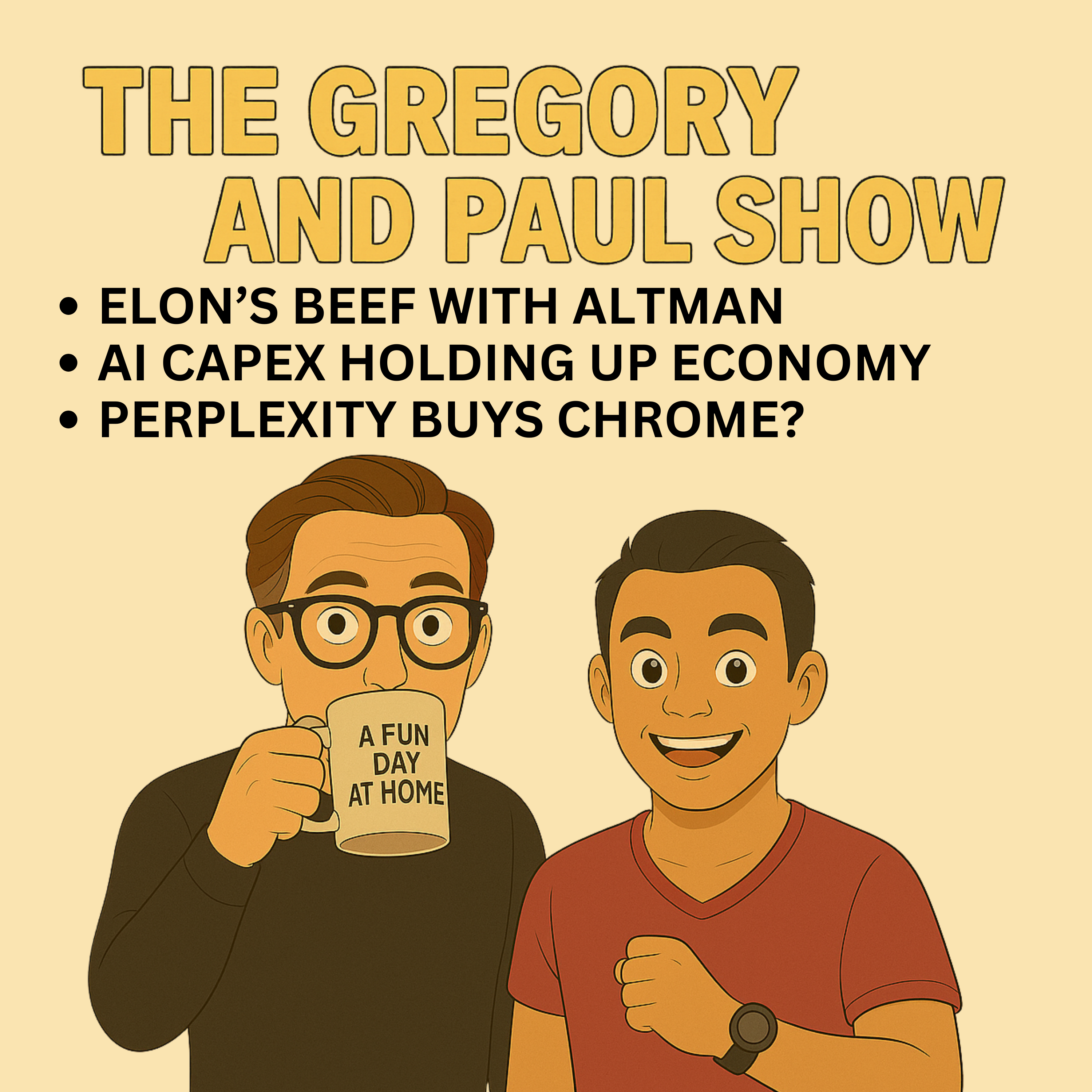
[00:05:28] Speaker B: Three really interesting topics. So first we'll do Elon, his beef with.
[00:05:34] Speaker A: His beef with Sam.
[00:05:36] Speaker B: I would say ongoing beef with Sam Altman. It's nothing new. They have a new saga or a new. A new one to be beefing about, but it's been going on for a while. We'll talk about perplexities, ridiculously hilarious offer to buy Chrome. I love it.
And then we'll talk about AI cap X spending and how it appears to be holding up the ENTIRE not just U.S. economy, but maybe the. Maybe the world economy.
[00:06:06] Speaker A: The world economy.
I know you have lots of thoughts on that.
[00:06:10] Speaker B: Kick us off with the Elon stuff. Do you want to share any tweets or anything?
[00:06:15] Speaker A: Yeah.
Okay. So the whole. This whole thing came out of, you know, a little bit of, like, beef between Elon and taking on Apple.
[00:06:26] Speaker B: So he's not a little beef. It's a. It's a big, giant beef.
[00:06:30] Speaker A: That's right.
So Apple.
So Apple signed a deal with OpenAI to leverage their tech ChatGPT across all of their iPhone devices. Elon also was not happy that Apple is prioritizing GPT chat GPT before Gro in the App Store. So Elon wrote this tweet a few days ago accusing Apple of behaving in a manner making it impossible for any other AI companies beside OpenAI to reach the number one spot in the App Store and, you know, accusing them of antitrust violations. Sam shot back and say, wow, what a remarkable claim. Where Elongated obviously manipulates X to benefit himself and his own companies and his own agenda. Right. So both of them kind of shot back at each other. Elon says, hey, Your post got 3 million views based on, you know, calling directly using languages like Eliar. Far, far more than I ever received on his.
Sam snaps back with a skill issue tweet.
Just amazing. Where. Where can you get this outside of.
[00:07:46] Speaker B: I'll tell you. I'll tell you and get it.
5th grade. 5th grade. Instagram Comments is where you get this kind of stuff.
[00:07:53] Speaker A: That's right.
[00:07:54] Speaker B: That's what.
That's what I think. Although I find it highly entertaining.
I don't know. Who do you think's right in this debate here?
[00:08:03] Speaker A: I. I don't think anyone's right. Like, absolutely no one is right. They shouldn't be arguing like this as adults.
[00:08:10] Speaker B: I'll tell you who's right. I'll tell you who's right.
Sam is right. Elon is wah, wah, wah, wah, wah, wah. And like, Sam is absolutely correct that, like, Elon is Putting his thumb on the scales of all of the content all over X all the time.
[00:08:25] Speaker A: Right?
[00:08:25] Speaker B: There's absolutely.
He doesn't even, he doesn't even advocate for the idea that the content would be shared on X is like somehow fairly weighted. That like it's some kind of marketplace of ideas, like, absolutely, Absolutely not the way X works. And so the idea that like, somehow the App Store needs to be fair is just a preposterous thing for Elon to insist based on how he operates. I think Sam is totally correct in this one.
[00:08:57] Speaker A: I, maybe you're right.
I, I think that's. I don't think anyone will say that, you know, X is fair. Right? Like, of course Elon used it as a platform.
[00:09:12] Speaker B: The funniest part is like, I'm not biased. Like, I, I personally, much, I personally love Elon. I think everything he's doing is really cool. I'm huge on that. What is that good thing?
I don't know.
I'm not actually as big a fan of Sam the way he operates, but I think, I think Sam is dead. Right? Like. Like, who are you to like, criticize, like, the fairness of how content is being surfaced on any platform? Elon. Yeah, I think that's, I think that's totally legit.
[00:09:44] Speaker A: Totally legit for Sam to call him out on this.
I think Elon is a credit being this.
We'll see where it goes.
[00:09:53] Speaker B: Hey, do you think this means that Elon is really worried? Like, he's like, perhaps losing. That's what I think.
[00:10:01] Speaker A: Yes, he's very worried. So, yeah, he hired a kid a beer, right. Had a product.
[00:10:11] Speaker B: Oh my God, I love that.
[00:10:14] Speaker A: I think a few days ago he tweeted he's now putting together the best Android Dream team ever.
[00:10:25] Speaker B: So why didn't Android dream team.
[00:10:28] Speaker A: Correct? So he's, he's like one of those originator where he originally said, oh, if you use Android, it's like a. A check repellent. You should not use Android. Android is like the lamest thing ever. That's true.
And now like, you know, he goes 180. And now he's assembling the dream team of Android.
Android Dream team to build the next amazing X Android app. So of course, like, you don't make these kind of massive pivots without being worried a little bit.
[00:11:03] Speaker B: I didn't pick this up.
I wanna like Elon and I want to like Twitter and I guess I would follow that. I do like Nikita, but like, I don't know if I like their strategy and so like I was looking at on the X app the other day, like did that, did the whole messaging thing get rolled back? Remember they rolled out this like whole new thing? X. Yeah, X chat. I was like, this sounds awesome. I can't wait for it. And then it just was like a version of iOS chat built in the X app, only on the phone, didn't work on the PC. And then you had to. They could. It was not backwards compatible. It's gone, right? Is it even? Did they roll it all back?
[00:11:45] Speaker A: I think I still have it on my phone.
[00:11:47] Speaker B: Just like the product strategy here is just, it's just like, it's just silly.
[00:11:55] Speaker A: Yeah, they, they don't have.
Yeah, correct.
They haven't released anything groundbreaking in a while and I, I just don't think they have the ability to retain top talent or attracting. Or attracting the wrong talent.
[00:12:13] Speaker B: Yeah. All right. We, we can't spend this whole time criticizing X.
Even though it would be a fun show. We have lots of AI news to get into.
So what do you have next?
All right. Perplexity.
[00:12:30] Speaker A: Yeah. This one was just.
I don't even understand why they would come here.
[00:12:37] Speaker B: You're against this. So what's your take on this?
[00:12:39] Speaker A: Yeah, so I.
So like the backstory is that obviously Google is going through a bunch of antitrust issues.
One of them, one of the rumors or one of the thing is the Justice Department wants them to break up Google, Chrome, Chrome away from all of their other, you know, advertising business. Makes sense, right?
Anti Trust. So there. That invites a lot of bidders and one of the bidder is Perplexity. I, I honestly think this is just Perplexities.
Grasping astros. I think they have. They launched Perplexity Comet as a competitor.
[00:13:19] Speaker B: Yeah.
Is that public? Have you tried it?
[00:13:24] Speaker A: So I saw some people really like it. I don't, I honestly don't even use Perplexity too much. I think.
[00:13:30] Speaker B: Yeah.
[00:13:30] Speaker A: I don't use Grock.
Claude covers pretty much all of my AI needs.
Yeah. I just don't see this as the future.
You know, we've talked about MCPS before.
I just think AI automated browser is transient tech.
This is a hell that I'm going to die on. I think plugging AI directly into browser is just complete waste of time.
[00:14:01] Speaker B: Oh yeah. So your take is that. Let me see if I can refinish. You're saying that this AI browser thing, that's just some stop on the road to ultimate and end game, which is like AI agents and it's basically automated and you maybe have an app Somewhere on your phone and you just kind of tell it to do things. And you don't really need to spend a lot of time in a browser.
[00:14:24] Speaker A: Correct. Yeah.
This is like if AI succeeds or if AI truly gets widely adopted, the browser makes no sense. Right. Like all web application and browser is doing is just wrapping a user interface around data.
[00:14:41] Speaker B: Yeah.
[00:14:42] Speaker A: If AI has direct access to data, we don't need to be sitting around a computer clicking buttons. Makes no sense.
[00:14:51] Speaker B: It's a good point.
Well, okay, so my take on the Plex thing, I think it's hilarious. I think it's excellent marketing. I like that they do these kind of bold, ridiculous things like they don't have the money to buy it. I guess maybe they could get it. It's possible, but I think it's hilarious.
[00:15:07] Speaker A: Yeah.
420 funding secured.
[00:15:10] Speaker B: Yeah, I think it's funny. I mean, who's gonna buy it? Like Oracle, like who has the money to do this micro? Like Microsoft, like so then the whole monopoly just goes back to Microsoft. It's kind of laughable, I think.
[00:15:25] Speaker A: No, I don't think anyone that actually has an AI strategy is looking at this.
[00:15:30] Speaker B: Who do you think is going to buy then?
Because it's not complexity.
Neither of us think like Perks. Not gonna buy it, Right?
[00:15:39] Speaker A: Yeah, no, I don't think so.
[00:15:40] Speaker B: But who else has the money then?
[00:15:42] Speaker A: Amazon, I mean.
[00:15:45] Speaker B: Yeah.
[00:15:46] Speaker A: So this is kind of, this is kind of the play, right? Like the way that this article is framing is Bezos backed Perplexity makes a bit for Chrome.
[00:15:56] Speaker B: Oh, and that Bezos would give Perplexity the money to do it.
[00:15:59] Speaker A: Yeah, because they're already backing, which is basically.
[00:16:03] Speaker B: It almost is like an exit for Perplexity if that happens. It's basically what happens. It's like a whole bunch of new money come in from a new investor and perplexity has to be rolled into whatever this new thing is to. Yeah, correct, correct.
[00:16:18] Speaker A: For Amazon, it makes sense, right? Like all of this browser browsing data, you integrate Amazon search directly.
[00:16:25] Speaker B: He's the only person I could come up with who can afford it. And like, so Microsoft can't buy it. Antitrust, even though you have the money.
[00:16:31] Speaker A: Right.
[00:16:31] Speaker B: Ellison? Like and, and Oracle conceivably could. And he's the kind of guy that would come out of nowhere just like.
[00:16:37] Speaker A: Correct.
[00:16:38] Speaker B: Yeah, he's the kind of guy wake up, be like, you know what, I really feel like I need to buy Chrome today. And he would just do it like he's got the money. Doesn't he talk to anybody just calls, hey buddy, let's just make this happen. And then boom.
[00:16:48] Speaker A: Right.
[00:16:49] Speaker B: It's the only guy I can come up with, I guess like Facebook could buy it.
They have, they can afford it. Right? Like Zuckerberg could like finance it.
[00:17:00] Speaker A: Yeah, but I don't think it plays into their.
[00:17:03] Speaker B: No, I agree with that.
[00:17:04] Speaker A: Right. Like their business.
[00:17:06] Speaker B: What if Apple bought it?
Apple has Safari but then still could like own Chrome. Right.
[00:17:13] Speaker A: But they're not getting to the antitrust again, I think.
[00:17:17] Speaker B: Do you think so? Yeah, maybe. I don't know. It's interesting search, right.
[00:17:21] Speaker A: Because they pay like Google a lot of money to make a.
Sorry. Google pays Apple a lot of money for the search.
[00:17:30] Speaker B: Yeah. Right.
[00:17:32] Speaker A: So if they own Chrome again, then.
[00:17:37] Speaker B: All right, so that's on the browser side. But on your second point about.
Is this just like transitory technology? So the other, the other angle would be that like look, there's a lot of websites out there and there's a lot of legacy users.
So when and if we get adoption of MCP servers and agents, which isn't a sure thing, it might not happen for anybody and it might not happen for consumers for a long time. But there's another like 10 to 15 years of web based interface interactions over HTML that are going to happen and it's a really big market.
So perhaps it's a legacy business, but I don't think it's going to transition to MC servers and agents very quickly.
[00:18:23] Speaker A: Yeah, so, so this is my, my take is that maybe not in North America. Rest of the world are predominantly on the phone use apps already. So the transition from apps to MCP servers is not that big of a leap. If you think of like how China operates. Majority of people uses app called WeChat to do pretty much everything.
[00:18:49] Speaker B: Yeah. And all that. Yeah, yeah, yeah, yeah.
[00:18:51] Speaker A: Right. So like you can pay your taxes instead of WeChat. It's loaded as a micro app. All of these services already integrated with the chat application. So the step from micro applications to like AI agent, MCP servers is not that a giant leap.
So that's, that's majority of the world. World. Let's say that's true. In terms of like America and like the, the Western hemisphere, I think we're just behind even in Europe, I think they use a lot of these channel applications. I know, I know. WhatsApp is super popular in Latin America. A lot of people pay the phone bills with through WhatsApp.
[00:19:34] Speaker B: So I hear you like the web browser too. Like as a mechanism I would even Go as far as say something like.
It's actually not the predominant way most people use the Internet.
The web browser is only one aspect of it.
Everyone uses their phone and they go in there and they use text and they share photos, they do instant messaging, they go on Facebook.
Regular people don't use a browser very much at all. And I think haven't for a long time.
The only use case is like you click on a link and it goes to like a blog or a new site somewhere and even that's like going away.
[00:20:15] Speaker A: Exactly. Yeah. I think majority of People just uses one or two SaaS applications, right? Yeah.
LinkedIn.
[00:20:24] Speaker B: Yeah. And Slack. Right. Like there's just so many other alternatives. No, I, exactly.
I agree with, I agree with that.
I don't think the transition. AI agents happen fast.
[00:20:40] Speaker A: We don't know. I think, I think if you can show people you can get a 10x experience, I, I honestly do believe it.
I think this is one of those use cases for AI that's going to get adopted much faster than everything else.
Because if you can, if you can literally show me something that I don't ever have to like open a web browser again, I, I will switch, I will use it.
[00:21:08] Speaker B: I mean AI agents right now are like in their infancy and then like the consumers or regular people are not using them.
So it's just going to take a long time. That's why.
[00:21:22] Speaker A: Well, like they don't even have to know that it's AI agent. Right. So for example, your, the way that you buy like SaaS services.
Right. It makes zero difference between you just going on to their MCP or you're just like typing into. Hey, I want to, I want to convert a PDF file. Sorry, I want to convert a website into a PDF file.
Right now you have to go out manually, acquire the service, put in your credit card, integrate it into your service, or upload a file. All of that could be now done using cloud directly inside of cloud.
So now what that means is your interface will be directly with the cloud app instead of going on to a web page or a SaaS application.
[00:22:16] Speaker B: Yeah, this is a broader. I mean this gets rather abstract I think, but it's an interesting point. So like, and I've written a lot about this, I do agree that like. Well, agree. I think it's even more dramatic, like long term. I think apps go away.
[00:22:38] Speaker A: Yeah.
[00:22:39] Speaker B: Like they get integrated into AI. So the way you describe. So you're describing a world where you open up an AI agent or you open up an AI chat assistant let's call it that.
[00:22:50] Speaker A: Yeah.
[00:22:51] Speaker B: So it's a chat GPT. It could be a perplexity. It could be a deep seq, it could be a Claude. It could be all these things. Right.
And then all these, like, services are embedded into it.
[00:23:01] Speaker A: Correct.
[00:23:02] Speaker B: And so you just kind of. And you don't even perhaps need to even know what they're called. You just say, like, make this website into a PDF for me, and boom, it just does it.
[00:23:10] Speaker A: Exactly. Yeah.
[00:23:11] Speaker B: So maybe it calls us, like, maybe it calls a server. Maybe it doesn't. Like, it's all opaque. Like, you don't really know what's happening.
[00:23:18] Speaker A: It's all opaque. Exactly. Right. Like, the biggest struggle from building SaaS tools that I've experienced is teaching people another tool to use.
Right. Like, that's the biggest problem with building any kind of software these days. And people are tired, they're like, oh, my God, I have to use another tool.
[00:23:36] Speaker B: Yeah. This is an interesting point. I'm sorry.
[00:23:39] Speaker A: That's it. It's like, if you can tell buyers that, hey, you don't need to learn another tool, I think that's huge.
[00:23:46] Speaker B: I think there's barriers to this. So I actually thought a lot about this. Like, I do agree that, like, some formulas will emerge or is emerging. Like, the apps is built into a chat interface. You kind of tell the chat what to do, the agents kind of do things.
But, like, certain things won't work that way.
There's still gonna be, like, branded services and commodities that people want to pick through and select. Like, the shopping experience does matter for some things.
[00:24:18] Speaker A: Okay.
[00:24:18] Speaker B: It's hard to. So. So, So I don't know where this new world goes exactly.
I even think that, like, I even think that, like, things that sound completely ridiculous right now might emerge, that, like, maybe the shopping apps have. Are the brand.
Like, I. I think that people like brands because I think brands are, like, a useful shortcut to kind of get what you want. And if you just go on MCP server, you just tell it to do something, it just randomly does things and you're like, this is not what I want. Like, how many times you type in a chat. Yeah, it doesn't really do what you want it, does it? But it's not what you want.
[00:24:56] Speaker A: Yeah.
[00:24:57] Speaker B: So the idea that there's some kind of branded. Maybe I'm putting my marketer hat on here, some kind of branded universe of MCP apps actually think it's quite conceivable, but I think the whole nature of brands just transforms and, like, it influences the behavior of the MCP server selection. Like it knows your preferences but like a lot of times too like people don't know what they like. They will. So that's why they like fake things like tastemakers. And everyone makes fun of thought leaders. But there's a reason those things exist because like they help people make decisions in a world that's really complicated and there's lots of choice and so trying to find ways to narrow choice. Yeah. So I see a whole future where branded MCP servers become the way you make these choices.
And like I actually don't even fully understand like what the brands will be. I think like a new type of brand.
Yeah, like a decision making brand. Like I guess it's kind of like how at least when I think of like very high end European luxury brands, some of them really went in the direction of being like they're like, they're like a lifestyle, they're. I embrace the Louis Vuitton lifestyle. I've got a Louis, I've seen these ridiculous Louis Vuitton bicycle and Louis Vuitton sneakers and she's like. So I kind of see like brands perhaps going in that direction where it's a preference or a way I like to do things and it finds those types of services for me.
[00:26:23] Speaker A: I, I, okay, so you're abstract.
[00:26:27] Speaker B: It's hard to understand. Right. But like I believe this world is going to happen.
[00:26:30] Speaker A: No, I don't think it's abstract at all. Because if you just break down exactly what you're talking about, it directly translates into the MCP world. So branding is really a trust mechanism. Right. Like you buy a brand because you trust it and inherently this brand will guarantee you a level of quality that you're used to.
[00:26:49] Speaker B: Yes.
[00:26:50] Speaker A: With mcp the biggest problem right now is exactly like you said, there's no brand. You can't guarantee a level of trust. So everything essentially will become productized as in maybe, you know, this is actually pretty simple is you pay when the goods is delivered and you know, we can then create a whole bunch of mechanisms around checking the quality of the delivered goods. So like you can do all of that.
So now really the thing that you have to make decision on is, I mean look, you can even like hire a MCP AI agent that determines the quality for you.
[00:27:35] Speaker B: Yeah, I think it's cool.
I believe 100 that like this. So I don't know how fast will come, I don't know if I think that HTML has gone away. But I do believe a future will emerge where there's these MCP server apps that are automated. They do things for you, they're branded and they're all new brands and they're based on like, they're based on the process the way they do things. Like, even your description of like, make this website into a PDF for me. Like, I want one that I trust to do it the way that I like it done.
[00:28:03] Speaker A: Exactly 100%. I think it's definitely not going to remove the human factor, but definitely also not going to be as completely arbitrary, let's say, like, why do you like, why do you like the difference between two luxury brands that sells handbags? I don't know.
[00:28:22] Speaker B: All right, we've talked enough about this.
[00:28:24] Speaker A: Cool.
[00:28:25] Speaker B: Let's. Yeah.
[00:28:26] Speaker A: Can I show off like, can I show off like a MCP demo?
[00:28:30] Speaker B: Of course.
[00:28:31] Speaker A: So like this company called Brutley, they are a dev tool they use. They built a MCP server to essentially help developers handle incidents.
This is inside of a cursor, a developer tool.
This cursor is set up to their MCP server. The MCP server essentially can fetch incidents.
Right.
So what's happening there is you're directly interfacing with their MCP server, pulling the latest incident now using that incident, asking the AI agent to implement a fix.
[00:29:20] Speaker B: Yeah, I think that like, I think a better term will emerge. So if you go to CLAUDE now, it's got it, it. There's more integrations than in the previous couple now there's like everything integrated and it calls them Claude, calls them connectors. Yeah, those are technically MSP servers.
[00:29:36] Speaker A: Yeah, Yeah.
[00:29:38] Speaker B: I think some cool term will emerge like, because like they're, they're. I kept thinking they're like power ups like in video games. Like I've got my little cursor unit, I've got my like chat GPT unit, I've got my like Claude interview, whatever it is. Right. And then there's there's certain like limitations or things that are hard to do with like let's call it base AI. And so I need power UPS to do like other cool stuff and that's what all these MCP servers are. They're just like, they're a little power ups.
[00:30:06] Speaker A: Exactly.
[00:30:07] Speaker B: They're not quite apps in the same way. Like the app metaphor on the, on the iOS mobile phone was very, very clear and branded a certain way.
They're different than that because like they're more, they're, they're wider reaching in terms of how they impact what you're doing and they can be integrated into things in A way that, like apps, we're basically self contained. That's probably the right way to describe it.
MCP servers, these cool power ups, they're not self contained. You can intertwine them and link them together and make them interact with each other in a way that apps couldn't. Which is, I think, super interesting. Correct.
Big difference that no one's talking about this stuff because it's so early. Basically everyone's comparing them to APIs.
But APIs are, in the same way I was describing, are static. You ping it, it does this service, it provides done MCP servers, they have an ongoing nature of the service and they can interact with other ones on their own, which are things that APIs cannot do at all.
[00:31:12] Speaker A: API is more rigid. It's still just a simple way for humans to consume.
[00:31:18] Speaker B: Yeah, and they're singular. You ping the API and it pings back. And that's it.
[00:31:22] Speaker A: Yeah, MCP. I mean, MCP just sits on top of APIs, let's say.
So at the end of the day, the developer doesn't have to change anything. You just have to put MCP Server in front of your API. So instead of exposing your API for human consumption, you expose the MCP server. It's just a more natural way that we should.
[00:31:42] Speaker B: Right. So I spent all weekend the Coinbase Hackathon talk about MSP servers. So the first generation of these is going to be. Everyone's going to build MCP wrapper on their API.
[00:31:54] Speaker A: Correct?
[00:31:55] Speaker B: Correct is what's going to happen the first generation. That's why in the beginning, everyone will just compare them to APIs, but then eventually it'll merge. The MCPs have a lot more features and functionality than APIs, and they'll do a whole bunch of different things.
[00:32:09] Speaker A: Correct, correct, correct.
[00:32:13] Speaker B: That one got real nerdy.
I don't know if anyone's following along, but that's okay.
[00:32:20] Speaker A: That's fine.
[00:32:23] Speaker B: All right, let's move on to AI Capex spending. This one, this one will be fun.
[00:32:27] Speaker A: We talked about this last night. You want to explain what we're talking about here again?
[00:32:34] Speaker B: Oh, do you bring up my Balaji thing? Yeah, yeah, yeah. So like, Balaji tweeted this thing.
So we got to set the context here.
Let's go the other tweet.
Yeah, so this one. Right, so this is like. Yeah, okay, so this the correct way to frame this is that all the economic data came out in terms of like gp. And this chart is AX Capex spending versus consumer spending. Right. So the. The line that looks like it's crashing is consumer spending. And the line that's going up, the dark one is AI capex spending. So consumer spending is usually what powers most of like the US economy. I believe this is the United States only and typically most of the world. And that's like 80% of what powers GP. There's always a business component to it, but this is the first sign that like the AI capex spending specifically has exceeded the consumer piece. And the AI capex spending is like all the chips and money that people are spending with basically Nvidia. Right. But all the data center built out. So there's lots of involved in Apple sizes chips but like Google, Microsoft, Facebook, they're all spending, Oracle all spending all this money and like it exceeded consumer spending. Right. So like a lot of people look at this thing like does it look healthy? The entire economy right now appears to be propped up by AI CapEx spending.
[00:34:13] Speaker A: Yeah.
[00:34:14] Speaker B: Which is concerning.
What do you, what do you have a take on that one?
[00:34:19] Speaker A: I, I think this is, I think America's moving towards late stage capitalism.
I, I, I don't so I mean like is it, is it bad? Why, why is it bad when so our understanding of how GDP grows is completely through consumption.
Right. Like people has to spend money on goods and consume things.
[00:34:49] Speaker B: Right.
[00:34:50] Speaker A: But that's not really the way that a lot of the other parts of the world thinks about GDP growth. Definitely not China.
Right. Like China's GDP is mostly about producing things.
Government spending is a huge part of it. For better or worse, consumer spending has always been trailing government spending. Chinese people love to save.
So I think this is just America's way of, I want to say mimic the way that China has been for the last 10 years, 15 years and yeah, I don't think it's a bad thing because America needs that kind of infrastructural capex.
[00:35:38] Speaker B: Interesting. So I agree with you that though like the capex fitting is good and like it does mirror some of the Chinese call it approach in the sense that China's been building all kinds of stuff and there's different reasons why China's building things relative to the United States that they, they went from like an agrarian, let's call it may perhaps backwards socialists set up under to a more modern 21st century infrastructure really short period of time. So they had to build a lot of stuff. So I think that that's why like construction, building all this stuff just ate up so much GDP because they were building so much in such a short period of time or the United States Perhaps like we've built roads and like power plants. All this stuff had happened a lot.
Really much longer. Yeah. Earlier. Right, so. So I agree with you that in the sense that like building these type of thing is good. Infrastructure in general is good too because like it generally powers the economy that you build a road, you build a power plant, you build AI chips and like you can build other services on top and you can build business on top. It's really, really good for business. So I agree with all of that. I think the consumer spending piece is really that all of the COVID stimulus has been spent. I think it took a long time for that stuff to work its way through the like US economy.
And it was like artificially propping up a lot of consumption.
[00:37:06] Speaker A: Yeah.
[00:37:06] Speaker B: And people are traveling, they were like buying things, they were doing, eating out. And all of that stuff has come to a halt because a lot of the money printing and other stimulus has run out. And like we haven't really done any stimulus. In fact like Doge and Trump and the things that they're doing economically are, you know, what's the term?
They're constricting.
They're constricting.
[00:37:36] Speaker A: Oh yeah.
[00:37:37] Speaker B: Spending. Right. They're not increasing. They're not increasing spending, they're constricting it. Right. So they're reducing it. And so that has implications. Right. And I think that like that's what that line actually means is that all that stuff has burned off.
I also think like your statement about like within China and like spending that, like putting all that money to work in terms of like printing money, doing stimulus and then giving it to consumers to spend. I'm not a big fan of it. I don't think it was very productive. I think it's what caused inflation.
You print more money and the money becomes worth less that is in existence and then people just spend it on services.
You don't really build any infrastructure or you put anything in place to grow the economy.
So it's generally not a very productive way to.
[00:38:28] Speaker A: Yeah.
[00:38:29] Speaker B: To use money.
So that's. Yeah.
[00:38:31] Speaker A: Sorry, I. I think, I think you're absolutely right.
I think it's. So the biggest problem with inflation and post covet is how do we cut back of all the spendings that we've done. So we have to put in a speederity measures to cut spending. But then the danger of that is if you cut spending, your GDP stalls and recession happens.
[00:38:58] Speaker B: So that's what everyone's worried about. Exactly.
[00:39:00] Speaker A: That's what everybody's worried about. And the thing that you could potentially save you from that is by spending elsewhere that doesn't contribute towards inflation. So this is where AI Capex comes in. Right. It's the most productive spending or at least it's what people believe is the most kind of productive spending we can do.
[00:39:25] Speaker B: Correct. I agree with that. Yeah. I think, I think the infrastructure spending is really healthy here. It's also private or public? Private. Like there's a mix.
[00:39:35] Speaker A: Right.
[00:39:35] Speaker B: It's basically private spending. Right. Which I think is really good.
Who knows if we're over building it. There's a lot of people who think that it's possible.
But if you look back from my perspective, like Dot com, where you had the dark fiber stuff was laid.
It eventually got used.
The housing boom, all the houses got used like 2008, 2010, like we have a housing Detroit still. In a lot of places they overbuilt. Perhaps southwest. I'm not sure they overbuilt. I just think they like there's just expectation in terms of price and construction costs that are mismatched. But I don't think there's an. I don't think we overbuilt. I think we actually underbuilt home still. So the capacity gets used up. So I think the same thing will happen with AI that like we'll build all this stuff and now we'll use it. Yeah, go ahead.
[00:40:26] Speaker A: It's very interesting, right? I think so.
You know, this public plus private spending is.
We're moving towards socialist territories a little bit. Just a little bit.
The danger here is will the quality suffer?
Right. Will money get improperly allocated?
Instead of hiring the best companies to do this, we hire second tier people who have no business building these AI infrastructures. Building them. That's kind of like the dangerous part.
If America can avoid that. I think this is absolutely.
Could be.
Could be great for America in the long run.
[00:41:16] Speaker B: It's interesting you said about like a more social approach. So I was thinking about that this morning.
[00:41:22] Speaker A: Yeah.
[00:41:23] Speaker B: What actually was like really important to define these things. I think that's something that's missed in all these conversations and that and to be. And like the simplest way I like to like let's say define socialism. Capitalism is a free market versus a centralized market. And I don't think this actually gets spoken about a lot, but the definitions are actually quite simple and easy to understand.
We have a free market. So literally like money gets created through the Federal Reserve or like banks. Like we have these systems in place and it gets distributed to companies and companies like they build whatever they want and they kind of satisfy the market, right? Try to invent a product and people buy it. Or you want to build a hamburger stand somewhere and, like, maybe it works, maybe it doesn't, right? Like, supply and demand is just, like. It's just something that, like, entrepreneurs and inventors or people are able to take advantage of. And either they can create it or they can't. But in a socialist economy, the concept literally is that some central planning committee is the one defining supply and demand. They're trying to estimate, like, how many hamburgers are we going to eat in Moscow in the year? And then, like, how much cattle do we need to raise in order to meet demand, to demand for that segment of the market? And that's literally what they did in the Soviet Union. They had, like, a. A team of mathematicians who, like, wrote out by hand and tried to determine everything in the economy and plan everything. And that's why, like, for the American perspective, there's these, like, stereotypes and rumors or something. That's true. It's not. That was, like, shortages and challenges because, like, it's very hard to do to, like, match supply and demand. And that the system of, like, manually trying to, like, determine it all wasn't very good at meeting supply and demand on both ends.
Supply was too low. The system couldn't respond correctly. I think this part is, like, really important to describe because in us and like most of Western countries, we don't have that. We don't have some central committee trying to match supply and demand and determine it all. We'd have a free market where, like, entrepreneurs create things, companies build things. Like Coke determines, like, what the supply needs to be for Coke on their own estimates, right? And maybe there's a shortage of Coke and maybe there's not, but they're very good at, like, not having a shortage of Coke. I've never had that in my entire. It's like. It's kind of laughable, right? Like, it's interesting that it's. It's funny to think that, right? Like, you're in an American grocery store and there's, like, unlimited supply of, like, junk food and all kinds of things, right? Which has its own problems. But we definitely do not have this problem, like, matching supply and demand. Like, we're very, very good at it. So that's why I think it's important, because when you think about, like, is it a more socialist policy or more capitalist policy? Like, we still have a free market in the US and so in my opinion, when people say it's more socialist. They're talking about the government intervening more into the market.
And you know, while obviously like, I'm pretty libertarian in terms of like, I think like having three markets is, is a good thing. I think they work really well. But I'm not like a laissez faire capitalist lunatic. Like, I think that there needs to be constraints and there needs to be systems in place. An example I always use of this is like the fda. I think it's a very good example of like in a free market you still need an entity like the fda, which gets a lot of heat these days, rightly so. Like, people are very critical of them, but without it, it's a disaster. So like complete disaster. The 19th century, like anybody could show up in your town and just like take a bottle of like alcohol and market it as a cure all, or maybe it's poison. And market as like a miracle drug is just not a healthy world to live in. Nobody wants that. Right? You can't have like medical frauds and fakes. Just be completely legal to market however you decide. And that buyer beware that like I bought this medicine that I thought worked and I take it and it kills me. Like, you can't have that worldwide. So I think like the FDA is a very good example of like, in a free market you still need government entities to have some level of enforcement to put rules in place about, like, what are the basic requirements in certain areas, particularly in like things that are dangerous or might kill you. Right. Like drugs. So. So in my opinion, that's a regulatory aspect.
It's not socialism. Social socialism is literally like central planning is like, how much medicine do we need next year?
[00:46:05] Speaker A: So I'll push back on that a little bit in the term. Well, bring it back to AI a little bit. Right?
[00:46:11] Speaker B: Yes.
[00:46:11] Speaker A: AI is one of the only industries where we're getting federally regulations before anything else, before even state, before even, you know, even the companies are put, putting out things themselves.
So that kind of like sets a tone a little bit where the federal government at the country level sees that AI is such a big potential risk. Let's say that they are preemptively regulating AI as a, you know, entire ecosystem. So I think that both like scares me a little bit and also it kind of creates a weird spot where, you know, states like California is now pushing back against federal regulation.
[00:47:05] Speaker B: That's a really good question. Right. So like, so where does AI fall into this spectrum of like, regulatory requirements? Right, Because FDA is such a clear example of where public good Nobody will. You buy a bottle of poison and it kills you like no one can. No one can argue that that's a good. Although there are, there are like, I think people who are too extreme and they do argue that too thing. I think it's quite laughable and it's not a mainstream view.
So the AI one is super interesting.
I think that like at this junction, it doesn't require a lot of regulatory scrutiny. I don't like, so far, AI hasn't proven to be a catastrophic technology that we need to control.
In fact, it's almost quite the opposite. I think that AI has proven to be like something that we need at like maybe even a national security level in order to compete effectively against other nation states.
So I do think that like the government has a role and it's enabling us to be the leader and have excellent AI technology because the military application is very clear. Like you need it in order to operate autonomous planes, drones, planes, whatever it is. Right, correct.
And that we need to have the best.
So that's where I see it. But I don't see a need, at least so far where like, oh my God, I have this thing running on my phone and it's like killing people.
Like.
[00:48:35] Speaker A: Yeah, yeah.
[00:48:37] Speaker B: I mean, there's these science fiction scenarios that, that seem to perhaps make that a reality, but I, I don't think it's a reality at all.
[00:48:46] Speaker A: Correct. So I'm kind of like, to cap that off, I'm a little bit worried that like us will shoot us. Shoot themselves in the foot with AI Right. Like comparing that to like the nuclear technology. Seeing the 50s, we kind of regulated it before it. It became a huge thing completely based on, let's say, the public fear of nuclear. Nuclear technology.
[00:49:18] Speaker B: Yeah. You know, my understanding is that like this in the beginning feel very excited about nuclear. And it wasn't a lot later that we understood there was like a lot of side effects to the radiation. And that's where a lot of the regulatory, what's called desire came from that in the Beginning, like the 50s, people thought like they wanted to put it on planes and like have all kinds of like nuclear stuff. And then it, then it was like, it took a while for people to realize that like, oh, there's this like weird side effect, like if you expose to radiation. Yeah, it's really bad for you.
And, and that's where like the public fear came from regarding nuclear technology.
So I don't know from what I can see with like AI right now, there, there's nothing like that like there's definitely some side effects. Like I think we need to like know how to like live in a society with it.
So some of these like AI powered psychosis stuff. Have you seen this?
[00:50:13] Speaker A: I have. Is. Are you talking about the GPT5 rollout or.
[00:50:17] Speaker B: Well, there's like all kinds of people who start to like get like lost in AI and I can see that actually is like a real concern like mental health, mental wellness that like you, you.
It's so powerful like in its ability to construct a universe around you that's fictional.
[00:50:34] Speaker A: Right.
[00:50:34] Speaker B: Like there's definitely certain people who can like fall into that and have some kind of AI induced psychosis.
[00:50:43] Speaker A: Right, right.
I think that's dangerous. I think that's.
[00:50:49] Speaker B: I agree.
I don't know how we, how we regulate it, but I don't know how we, how we do that. But they always have to figure a way to. Well, so I mean chat. GB did try to put new features in. I don't know if that'll fix it, but I do think it's.
[00:51:05] Speaker A: They rolled back. So they rolled back the.
It's GPT 5 or nothing.
[00:51:11] Speaker B: Oh, you can get GPT 4.
[00:51:14] Speaker A: You can, you can get everything now again.
[00:51:17] Speaker B: Ah, I didn't. They, they were restricting access before.
[00:51:21] Speaker A: Yeah. So before in the dropdown you couldn't access any other legacy models besides GPT5. And now they rolled that back and now you can go back to your, your previous romantic partners.
[00:51:38] Speaker B: Well, they, yeah, they weren't backwards compatible either. Right. Like, so I had a lot of people saying that they had to like redo everything and correct GPT5.
[00:51:47] Speaker A: Yeah. So people are, people are very angry about that.
[00:51:52] Speaker B: All right. Was there anything else that we needed to share?
[00:51:54] Speaker A: That was a, that was a good, good.
[00:51:57] Speaker B: That was a deep one.
[00:52:04] Speaker A: Yeah, I guess like to cap that out, like, do you think overall, any predictions around recession? Do you think.
[00:52:10] Speaker B: Okay, predictions. That's good.
[00:52:13] Speaker A: Do you think looking at the trend line that we showed, do you think a recession is looming?
[00:52:20] Speaker B: Right. So the consumer spending stuff. Yeah. Before we got caught up in describing and defining socialism versus capitalism.
Yeah. So you know, like, like I would. So I think the parallel is to the business cycle in general that, that I've seen over the long term with technology.
So like in the dot com boom you had a similar phenomenon where a massive build out of technology, companies, investment jobs, just like everything was way tilted towards high tech and too many people entered the field, too much stuff was built, too many things that like weren't perhaps useful got built too.
Right. And so you had some winners emerge, but there were like a lot of losers and it took a while for the economy to like absorb all that. I mean Amazon and ebay, there are a lot of companies that came out of the dot com boom that are still, you know, some of the biggest companies in the world. So like even though at the time there was some skepticism towards like the Internet and then there's frustration, the fact that there was like what they would say was over investment, it did yield some of the most incredible companies ever. So like I would argue that like it worked but the side effect was that you had kind of this like maybe almost 10 year period of stagnation. Right. The stock market didn't go anywhere from like 2000, 2009, you know, these people that were in high tech and entered that field and how to get reintegrated into other parts of the economy.
And I think we're seeing a similar cycle now where you had like let's say 2010 all the way through the pandemic where just there was even more enthusiasm and excitement about in general crypto boom.
You had a number of different trends in addition to the AI boom now. Right. So just like all of this investment in the space and I think similar thing happened that too many people build too many companies and we just don't need all of that capacity. And AI is a really interesting technology where you know, you and I both were debating this, right. Like is it really taking jobs away? Is it making things more efficient? And so I would say from my own personal experience, yes, there are things that like I used to need other people to do that I can do myself. So like I can use, I can use Claude to like Vibe, code Python and create scripts and do things that were not easy for me to do before. I could do them pretty easily now needed to actually hire someone or work with a team that could do, do those things. So there's a lot, a lot of value and a lot of like efficiency I'm getting and so I'm seeing that my personal, like my personal life.
[00:55:12] Speaker A: Yeah.
[00:55:12] Speaker B: So I, I think that like what this means for the economy is that some it's real in terms of like reducing the need for, the need for employees in tech.
[00:55:25] Speaker A: Yeah, I so definitely out of this AI think, I think tech workers especially so a lot of, a lot of scaring the developer community, right. Like we debate all the time, will AI AI replace us? Will we out of, be out of a job?
I, I have a bit of an insight on that that right like exactly like you said. I think business overspent on the salaries and contracts of developers during the pandemic.
One hundred thousand dollar contracts were a thing.
Immediately after the pandemic, I think that halved to like $50,000 and now with AI, $5,000, $10,000 for MVP build.
But the, that's not kind of like my core argument. My argument is I think a lot of developers forgot that you could just change your price.
Right. So a lot of developers, because of the pandemic, they think that they have to be paid a certain number and they're self selecting out of the job industry.
Right. They, they refuse to take a step back and say, hey, I got paid mid six figures during the pandemic. Getting paid anywhere south of that or below that is, is a defeat. Is a major defeat.
[00:56:45] Speaker B: Yeah, they can't adjust.
[00:56:46] Speaker A: Yeah, right. They can't adjust either through like real situations like lifestyle creep.
I think that's really at the core of the issue is a lot of people refuse to adjust to pricing.
They're sitting on the sideline, either burning through savings or doing small things on the side.
[00:57:15] Speaker B: Yeah, I, I know, I think that that's just supply and demand.
Yeah, there's a point where they could command those salaries and it was realistic. Now it's not. And so I think it's also normal that it's normal that the adjustments are hard. So economists talk about these things in the abstract, right. But the reality of like you made a certain amount of money and you have a certain lifestyle and you're a certain level of experience and that maybe doesn't command the same rate in the market is tough for people.
And so I think that there's only a few scenarios that are like gonna happen. Right. It's like, yeah, people stay in it because they like it. And that's me. I thought this was awesome my whole life.
[00:58:00] Speaker A: Yeah.
[00:58:00] Speaker B: There's other people who decide to do something else, which is fine too. Which is totally fine too.
And then there's people who just like, they kind of resist. Right. And I think, I think that path is what I don't advocate for. I think people are like really unhappy who just can't evolve with the, with the market, you know, and they all have to find a way.
[00:58:24] Speaker A: I've, I've heard the saying where, you know, during these kind of times, tough times, that's when the next generation of billion dollar companies start. Right? Like exactly like Amazon, ebay, they came out of the dot com bubble. Now they're one of, you know, some of the largest companies currently.
So I think, like companies that starting today, startups that's starting today will become in 10 years, some of the largest names.
[00:58:52] Speaker B: I think it's a great way to end the show today is that if you look back at the cycle 2008, 10 is when some of the greatest, most interesting companies from Silicon Valley got started. Right. Like Airbnb, Dropbox, that whole cohort of companies that that Y Combinator was able to grab into. Because then typical, like, let's call it the standard venture capitalist world was struggling because of the great speed they were.
[00:59:25] Speaker A: Yeah.
[00:59:25] Speaker B: Recession. And so Y cameras will step in and fund those companies. Right. And had all these wonderful exits and funded some really creative, really interesting companies. So I think you're correct. Like, we're in that stage of the cycle where they're shedding all these jobs at big companies and there's going to be people who are going to really invent some cool stuff and there's a huge opportunity to do that with AI.
[00:59:45] Speaker A: 100%.
[00:59:47] Speaker B: All right. That was fun, dude.
[00:59:49] Speaker A: Awesome.
[00:59:51] Speaker B: We're good.