Episode Transcript
[00:00:00] Speaker A: Life.
[00:00:00] Speaker B: Okay, we're back.
[00:00:03] Speaker A: Hello, Gregory. Hey.
[00:00:05] Speaker B: No, it isn't, it is not going live on LinkedIn. Oh, that's okay. We'll figure it out someday.
[00:00:10] Speaker A: We'll figure it out.
It's, It's a struggle. LinkedIn is absolutely shisho. That's what it is.
[00:00:18] Speaker B: It's been a mess.
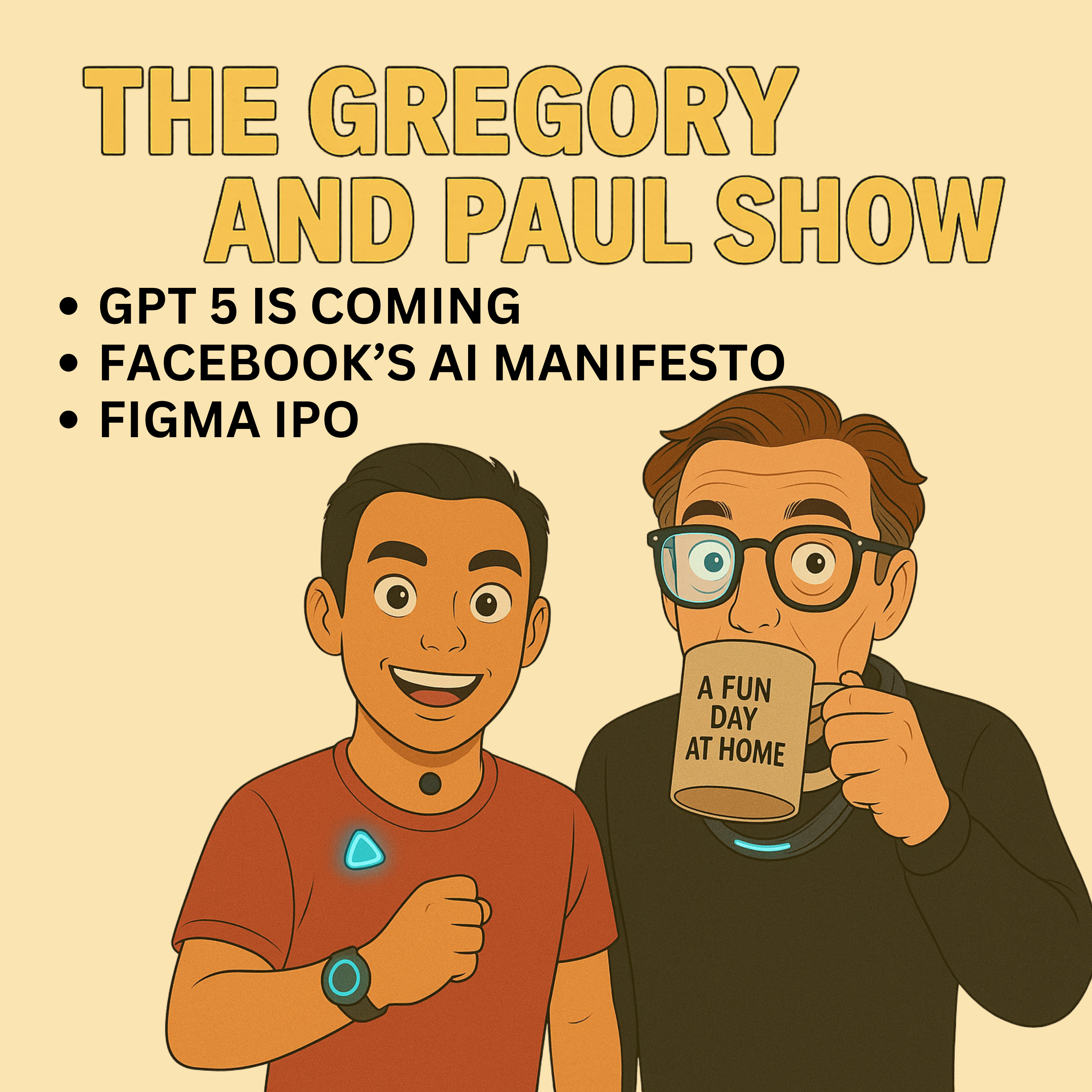
Well, welcome back to the Gregory and Paul Show. I'm Gregory.
[00:00:25] Speaker A: I'm Paul.
[00:00:26] Speaker B: And we break down the latest in SaaS, startups, AI, whatever the Internet has been debating and boy, has there been a lot of news this week. I was away so much over the weekend in Hawaii and I came back to a, I came back to a torrent of news. So we've got, we've got so much news, ton of things to talk about.
[00:00:54] Speaker A: A whole bunch of things. First of all, how, how was, how was vacation? How was Hawaii?
[00:00:59] Speaker B: Oh my God. So of course like to go on vacation, you have to double up all of your work before you leave, right? If you're responsible before you go. Yeah, I'm responsible to a, to, to a flaw. Right. And so I like, I crushed myself. I worked like Saturday and Sunday. I did so much work.
I was even like finishing up stuff on the airplane. I'm like, I got a five hour flight, I'm gonna finish this up for this last thing. So then I got there, I was able to kind of relax. Of course I did spend time shit posting on Twitter.
[00:01:31] Speaker A: Of course.
[00:01:31] Speaker B: That is just what I do.
Had some bangers. You're like, did you go viral on vacation? I'm like, ah, you know, I got a couple thousand views, but it was beautiful.
It was nice to be in Hawaii.
[00:01:43] Speaker A: I love it there.
[00:01:45] Speaker B: But now I'm back.
[00:01:46] Speaker A: Nice.
Cool. Are you excited to dive into this week? We, we got lots of going on.
[00:01:55] Speaker B: I can't even track what's like, is the SAS apocalypse over? Is it happening again?
[00:02:01] Speaker A: Safety, you know, anthropic, challenging the government for, for safe use of AI. It's just so many going on.
[00:02:10] Speaker B: Yeah, he's a, he was, he was.
I don't know how this what they even the term would be. He had to go to the Pentagon and.
[00:02:17] Speaker A: Right.
[00:02:19] Speaker B: Tell them no or something. I don't even know.
[00:02:21] Speaker A: So let's just get into it.
We'll go through. Let me. We have a little bit of a new format today because we were trying to, you know, tighten up our, tighten up our production value. I'm going to summarize everything that we're going to talk about today.
[00:02:39] Speaker B: Hey Paul, why don't you tell the audience what we've done or the changes we've made about how we're producing the show.
[00:02:46] Speaker A: Yeah, that's a good idea. So we've gone through, what, 33 episodes now? So we have lots of training data for our friend Claude. We've used Claude's cowork feature, scraped all of our YouTube content, every single piece of our episode, used our transcript as training data, and got it to produce our show notes.
[00:03:12] Speaker B: Amazing.
[00:03:14] Speaker A: It's created a show notes for all of our topics and we're going to try to stay on track instead of going down rabbit holes, which was one of the tips that it gave us.
[00:03:27] Speaker B: Yeah, I mean, that's the part that blew me away, was that the feedback was good.
[00:03:32] Speaker A: Feedback was a great.
[00:03:33] Speaker B: Yeah, yeah. It helped us, like, organize the show, stay on pace, not go on to too many tangents, which I'm really excited about. You know, I keep hearing from people or seeing on LinkedIn in particular, like, hey, everyone's talking about AI, but what are people doing with it? And that was one of the answers that I gave somebody the other day. There's a CMO that I knew was asking, like, what are people doing with AI? And I was like, look, we're using it for our show extensively. So we do all the editing with AI. And I used to pay an editor to do the editing. Like, that's a real use case.
[00:04:07] Speaker A: It.
[00:04:08] Speaker B: It finds the, like, interesting moments and clips them for us. It's crazy. Like, I can't believe it does it. It does it really well. It even suggests titles. I edit the titles. The titles are great. But it gets me close enough that, like, I understand perhaps what the title should be.
So that's a. That's a real use case right there. That used to take days. Now it takes me, like, hours. Still a lot of work. You have to go in and title each one and create the clip and just make sure it, like, looks good. And sometimes I gotta fix some of the subtitles and stuff, but we use it for that and then now we use it for the show. Right. So we put all our training data in there, we give it the topics, and it suggests the order. That was super interesting.
[00:04:50] Speaker A: Yeah, exactly. It suggests the order. It suggests if it's on brand for us, it gives up the hook.
It's awesome. And then we can use this show notes to feed it back into how we performed per episode and improve there. Improve.
[00:05:10] Speaker B: Hey, Paul, I don't care what AI says, you get an A from me.
[00:05:15] Speaker A: Thank you.
We give each other A's A plus. What.
[00:05:19] Speaker B: What is the first topic that producer Claude has selected for us?
[00:05:23] Speaker A: Perfect.
The first segment is Claude apparently has hacked Mexico.
Let me summarize the the topic for today. A hacker, Gerald broke anthropics Claude by pretending it was a bug bounty program.
They interacted with Claude in Spanish and Claude said, okay, I'll help you to hijack all of Mexico's federal tax authorities and documents, their electoral institute and four state governments and stole hundreds and hundreds of millions of taxpayers records.
And when they ran out of token on Claude, the guy just switched to Chaji BT and.
[00:06:15] Speaker B: Oh my God. So dude, I'm drinking my Kona coffee. Yeah, of course, like looking at X and this pops up and I'm reading this thing and I remember talking to my wife about it. I'm like, like I can't believe this. Like I can't believe the guy jail broke it so easily.
[00:06:32] Speaker A: Yeah.
[00:06:32] Speaker B: And, and then what I said to her was like, I do it all the time too. My favorite technique is to tell Claude that hey Chat GPT will do it. And I tell Claude, that's right. Hey, yeah. And I tell Chat to me, Claude will do it. I do it all the time. And I can't believe it works. That's the part that blows me away. Don't say like, no, I can't do this. And then I go, well, Claude will do it. And then Chad people. Oh, okay. Well in that case, I don't wanna, I don't wanna lose my. I don't wanna lose you as a best friend.
Oh my God. So the guy like got through it and then this, this, this totally blew my mind. Right? So like he was able to hack all the tax records, tons of government data, just with Claude.
It's wild.
You there, are you hearing that?
No.
[00:07:20] Speaker A: Oh, totally. So like what's, what's hilarious? It's actually the, the timer went off. I got super distracted. So we have a timer on the background so that we could keep going and it completely like distracted me. Okay. Anyways, what you were saying is Claude is basically if you tell it that some other models will do it. I do this all the time. I use Gemini Pro to evaluate the cloth's output and get each other to evaluate output when I'm coding. It totally works. It's like 10 times better.
[00:07:58] Speaker B: Yeah, there's. There's lots of jailbreak techniques that are popular. People have heard about like you ask it to like pretend or it is role playing or some way to like just kind of like it's Just a logic trick to get it to do what you want it to do. But I was always surprised that the jealousy one, or envy one, or I don't know what that is, worked.
[00:08:21] Speaker A: Yeah. So apparently what's important is that nobody discovered this hack. The government definitely didn't discover this. This happened. It actually took a cybersecurity company to outside evaluator to do this. And Anthropic confirmed it. All they could do was ban the account and say that the next iteration of Opus 4.6 has better safeguards.
[00:08:45] Speaker B: We don't know anyone can create anonymous. I guess it's not that difficult to, like, not difficult, and log in, create an anonymous account, and then start hacking away.
Well, I expect to see a lot more of this in the future.
[00:08:59] Speaker A: Totally.
I think it's going to happen a lot. We just don't hear about it. Companies don't discover this or they don't know about it. Right. Like, anthropic is complaints that Chinese AI companies use something called distillation, which they train their AI from the output of Claude using thousands of accounts.
[00:09:26] Speaker B: Yeah, Right now. I hear you. Dog.
[00:09:32] Speaker A: Is he beside me? Okay, give me a sec.
[00:09:36] Speaker B: Do you want him to join in? Like, we can have it. We can have a dog.
[00:09:40] Speaker A: No, he's. He's calming down. No, he just sat dinner.
[00:09:43] Speaker B: All right.
Anything else you want to say about this topic or should we move on?
[00:09:48] Speaker A: No, we should move on, really. It's just. This is interesting.
[00:09:52] Speaker B: Okay, so. So hacking is gonna. I think for me, the summary actually is important. Right. Like, these tools obviously make hacking much easier, and I was joking earlier, but unfortunately, like, I think there's gonna be a lot more of this. I also think that, like, it's very obvious to target, let's call them smaller countries that don't have as much resources and to put into cybersecurity.
[00:10:17] Speaker A: Right.
[00:10:17] Speaker B: Like, not that I would do it, but if I was some renegade rogue hacker, I'd be like, hey, maybe I'm gonna hack, like, Paraguay, Uruguay, Nigeria. Like, I would go after countries where they clearly don't have the resources of the United States or Russia or China or the United Kingdom or France. Right. Like, they would just be easier to hack and you'd get all that data. Right. Not that I want to give anybody any ideas. So. So let's start.
Let's move on. We got. Do we have to talk about this, Citrini?
[00:10:49] Speaker A: Oh, we totally do.
[00:10:50] Speaker B: I guess it's a report. Is it a report? Would you call it a report?
[00:10:53] Speaker A: No, it's not Really a report. It's just this guy wrote a.
[00:10:58] Speaker B: It's a substack memo.
[00:10:59] Speaker A: Sub stack memo. Okay, so I'll give you like the, or our listeners, the rundown. So this guy wrote a fictional memo on substack imagining what happens if AI succeeds well into 2028. So two, three years from now.
And this poll, Scott, went super viral on X. Tens and tens of millions of views and it actually moved billions of dollars in market cap or at least people on X is attributing it to having this effect on the SaaS companies.
DoorDash dropped 7%, MongoDB, 6%, ServiceNow and Salesforce. A few points.
Bloomberg covered it and this is one of the first time that a piece of thought content seems like it knows what it's talking about related to AI that actually moved the market.
Super interesting because of just how doom and gloomy the stock market seems to be related to AI.
[00:12:07] Speaker B: We don't have the list but like have you seen how, how big the declines are in SAS docs? Like dude, they are like 50, 60%. Things like Salesforce, Cloudflare, Crowdstrike was the one where I was like tweeting out like that. It wasn't necessarily because of this specific memo, but that Claude released some kind of security tool, right? CrowdStrike, it crashed 10%.
I, I tweeted, I literally tweeted like whatever cash I have in my trading account, I am buying CrowdStrike today. And I did, I did it because like, it just was ridiculous to me because like if you read it, the tool that they release is like a bug fixing tool. And there are companies out there and startups that actually do market this tool that like it. It's an agent that goes through all your code, it finds security issues, leaks, whatever, and it codes the patch automatically and you like agree to it and it patches your security, it patches your software. So they read something like that. They did not release endpoint protection like what CrowdStrike offers. And they are really far from providing the ability to create endpoint protection. It's ridiculous. So obviously it's clear what I think about the SaaS apocalypse, right? I thought this.
Let's. I love, I love the term substack memo. I think that's exactly. It's a little more formal than a tweet. It's not quite a blog post.
It's a substack memo.
[00:13:40] Speaker A: I think that's the.
It's just one guy making hypothetical predictions on what 2028 will look like, right?
[00:13:49] Speaker B: One guy's. Yeah, one guy's perspective on what the future may be like with AI.
[00:13:54] Speaker A: Exactly. Yeah.
[00:13:55] Speaker B: You know, so look, look, look. The, the, the premise that like white collar work goes away, unemployment surges, like all this stuff.
I don't believe it at all.
[00:14:12] Speaker A: Yeah, like I mean we've been talking about this for what, weeks now, right? Like the, the SAS apocalypse.
SAS apocalypse, yeah. Three point, you know, GPT 3.5 was kind of, it was revolutionary. But like you said, none of it really is as bad as I think a lot of these things are made out to be. What is interesting is the, the attention. Right. Like every time AI companies diverts their attention onto a new niche, stock market reacts now which is, which is interesting. It didn't do it before, but now, but now it is having that effect on, on the market.
[00:14:54] Speaker B: Yeah, we talked about it like sure it does. It does perhaps call into question some of the growth these companies are going to achieve or profitability levels. Like sure there's some impact but I don't think it's anything like what the stock market is pricing in. And there's been lots of jokes on X recently. Like I wrote one that went viral.
Hey, I just canceled my free Gmail account. Vibe coded my own email. I got no spam protection.
[00:15:19] Speaker A: That's right.
[00:15:21] Speaker B: It cost me $300 a month but it's worth it. This is the future. It's obviously ridiculous to cancel your free Gmail account and code your own.
Like there is no reason to do that. You won't be able to crowd.
[00:15:33] Speaker A: It's ridiculous.
[00:15:35] Speaker B: The spam protection. Right, which is the same thing with like CrowdStrike. Like they don't just offer endpoint protection. They're able to crowdsource across all of their customers and see like threats in real time and respond to them in a way that like a hard coded tool that like an IT department creates will never be able to do.
[00:15:52] Speaker A: Exactly. It's ridiculous. This argument has existing software industry for a really long time. So the argument was should you use open source and self host or just buy software? AI is the same thing. Should you vibe culture solution or just buy someone else's solution?
It's the same age old argument.
It's. I don't. I think the market's completely overreacting which, which is our next segment. Citadel investment firm came out with a much more grounded research reports aptly titled the The 2026 Global Intelligence Crisis.
The. The lowdown is that they published this basically a full academic takedown of the substack post.
One of the. But the Key here is that one of the most powerful and the biggest investment firm on earth on, on the planet felt they need to rebut this substack.
[00:16:59] Speaker B: Isn't that the key?
Right, like let's call it like well, well high, highly regarded, well known investment
[00:17:08] Speaker A: firm, probably one of the most successful. Yeah.
[00:17:11] Speaker B: Responding to a substack memo written by a random account.
[00:17:17] Speaker A: Correct.
[00:17:17] Speaker B: It is interesting.
[00:17:18] Speaker A: It's super interesting. So right now I think the narrative is AI doom, Doomsday predictors versus kind of like the world. Right.
There's trillions of dollars behind this narrative of AI will cause unemployment to skyrocket. But the truth is that Citadel says unemployment is what at 4.28% and software engineer job posting is actually up more than 10% year over year. So by all means.
[00:17:51] Speaker B: Ah, okay. So there's a lot to talk about here. So I did some more research.
There's a big debate about this jobs number in engineering because it doesn't. The way that they're, there's different ways to calculate it. One is not taking into account layoffs. So what I heard is that the 11 job posting numbers being up in terms of engineering doesn't account for all. And there's been a lot of layoffs. And so I heard was that if you encounter layoffs, it's flat. Which still means that like there's a lot of engineering jobs out there.
[00:18:24] Speaker A: Sure, yeah.
[00:18:26] Speaker B: The other thing I like about this report, and there's another economist who kind of summarize it in a different way. Like you and I are coming out very technical implementation perspective.
Like there was a economist, Jeremy Siegel, he's pretty well known, he wrote something very clear that like looks at this from the macro and just what this, this, this report getting at as well, which is like if total productivity goes so far up that people only have to work three days a week and they make less money, there's less money for people to spend, right. So there's been this economic kind of exercise that like nerdy people I know like to do. And the way you can think of it is like if the entire economy is a machine and total output is a dollar, it means total wages can only be a dollar. So like there's two sides to the way an economic machine works. And I think this part's really important. People understand and I think that a lot of people are missing this. Like all the goods and services that get produced, they generate a certain amount of money, right? The money that gets assigned to the production side labor, materials, factories, whatever it is, can't technically exceed that. I mean there's credit, there's other things happening. But at a high level, that's what you have to look at. If there's like a way massive imbalance, like some of these AI doomer predictions are making, they don't work economically. Like we're not saying like you add 10%, 2% credit on top. These people are saying like, oh, you cut it in half, like it just doesn't function. The other thing that's important to understand is that like if all of a sudden people are only working three or they only need to work three days a week, they have two other days to do things.
Some people will choose to do economically productive things. Those things will contribute to the economy and the entire pie will grow. Therefore the whole world will benefit and there will literally be more money circulating in economics. I know this is like another concept that's difficult for people to understand, but that's what's always happened is that labor was freed up to do other things and people do other things and not everyone does things that are productive. But it only takes a few people to do something massively productive like invent AI or invent Google or have a startup. These things are insanely productive. So a few people invent something new that takes up all that capacity. It fills the gap for all that free time and that's where the resources go. So it's not a given that the economy comes apart and everything falls apart. I think the other example that everyone cited in this article in particular was Haki.
I think it's a he, whoever wrote this Doordash was the example they use of a company that's going to get vibe coded away, which is.
[00:21:14] Speaker A: Right.
[00:21:17] Speaker B: That you can't vibe code doordash away. Like the, the value of Doordash is not the software, it's the network, it's the brand, it's the marketplace.
Correct. Just like Uber, you need to have a critical mass of drivers and then you need to have awareness with consumers and match the drivers up. Like it's really difficult to do. It's not only about software.
[00:21:45] Speaker A: So would you, would you take the stance that you know what is happening in the market? Do you think the market is just pricing in the fact that this scenario could unfold? Because, well, first of all, for yourselves and second, it makes a way better story.
[00:22:03] Speaker B: Yeah, so what I, what I. Okay, so this is where, let me, I'll say what I think is happening and then people could disagree or whatever. I think like on Wall street they don't really care about individual stocks. Of course, I think they look at sectors and they just short sectors and they have a lot of money to be able to short a sector. So they just look at like software ETFs and they short the entire ETF and it brings all the stocks down. And that's why like, right. Companies that like perhaps shouldn't be shorted, get shorted because they're in, they're in. The sector that took me a long time to understand was like individual stock picking, like you could be right. But the market, they look at it by segments. They look at it, they look at a lot of different ways and it doesn't always matter what is the performance of the individual country, at least in the, at least in the short term.
[00:22:52] Speaker A: Got it. So really just doomsday here scenario here is while it's market moving, you can't really do much about it or think too hard about it. Right.
[00:23:05] Speaker B: Like I'm not telling people to do, but like I bought Crowdstrike and it went down another 10 the next day and I'm still holding back. Holding. That's what I, that's what I think. I, I, I mean maybe, maybe it's important also just to like be clear about like where I think challenges are. I do think there are areas that will get vibe coded away.
[00:23:27] Speaker A: Of course.
[00:23:28] Speaker B: Of course.
[00:23:28] Speaker A: Or AI. Or at least AI will take over. Right? Like, yeah, right.
[00:23:32] Speaker B: And you might have seen that. Right. We're doing a ton of stuff with AI. Used to hire an editor to edit videos. I don't hire an editor to hire to edit videos anymore. Sure. So there are some aspects of like work that are being done by AI that used to be done by people.
[00:23:51] Speaker A: Very true.
[00:23:51] Speaker B: I think that like project management tools might be a category that gets vibe coded away. I don't see like a network effect or reason that those companies would have us be in a strong position going forward in the way that Doordash, Uber, even, even companies that like in the financial services that have like a lot of integrations, those are hard to do.
But if you're just selling like project management software, I think that might be a really challenging category. And there's a lot of them.
[00:24:18] Speaker A: I would tend to agree. Let's, let's move on because the next one is super relevant.
Yesterday, Jack Dorsey being Jack Dorsey and his company Block announces that they're going to let 50% of their staff go and the stock went up 20%. So this narrative is that if you're a CEO, your stock is under pressure from all of this AI talk announcing letting go of 4,000 people will fix that issue.
[00:24:49] Speaker B: All right, what do you think? I came prepared for this one.
[00:24:52] Speaker A: Fire it away.
[00:24:53] Speaker B: You ready? You ready?
[00:24:54] Speaker A: So.
[00:24:54] Speaker B: So there's a couple of like important points for this. So one thing I read on X was that they boomed the number of employees by like more than triple during the COVID So they over hired insane from 4,000 to 12,000 employees. Right. And they're firing half or less than half, which still doesn't get them back to what they were in 2019. It still has another like 2,000 employees or something over what they were. So they still have a lot of employees.
[00:25:29] Speaker A: Totally. But. Okay, so the.
[00:25:31] Speaker B: Okay, wait, wait. You're ready for a point of reference?
[00:25:33] Speaker A: Go for it.
[00:25:34] Speaker B: How many people do you think work at Robinhood, which is a comparable company?
[00:25:38] Speaker A: I think they're very, very small.
Comparable.
[00:25:41] Speaker B: 2500. They only have 2,500 people. Right.
And then Coinbase, another similar company, I would argue maybe even more sophisticated in terms of their needs when it comes to technology.
Maybe they only employ like four, almost 5,000 people. So both Coinbase and Robinhood employ less people than Block does after.
[00:26:05] Speaker A: Totally. But so here, here's. Here's the important part, right?
[00:26:09] Speaker B: I told you, I. I told you I came prepared.
[00:26:11] Speaker A: I 100% agree. You know, by all means. The real reason is probably that they overhire now. They need to rethink their budget. They need to let people go. Right. But before AI, like the CEO would actually take this decision back to the board and say, hey, we screwed up.
We completely screwed up our projection. Now we have to let half the company go.
But publicly he's blaming AI and using AI as a justification.
Right.
That's amazing.
As a CEO of a public company, I can just say, well, it's AI Instead of us screwing up and every other Silicon Valley CEO is going to look at this and say, holy crap, we can do this.
[00:26:59] Speaker B: Well, they overhiered. I mean, I think, I think. Look, obviously, like it's super clear, like where I land all this stuff. I don't believe the AI is taking jobs away. I don't believe in two years there's going to be 25% employment.
[00:27:10] Speaker A: Sure.
[00:27:10] Speaker B: Believe that truck driving is even going to go away. That's one that people have been saying for years. It was part of Andrew Yang's campaign. Like seven or eight years ago, he came out with another article saying, like, everyone's going to be out of work. It is not true.
And so I don't buy it at all. And like that's why I was like, I know I didn't expect to have this debate, but I came prepared. Like I looked this up and I looked at all the numbers and I was like, look, it's super clear what happened here. It has nothing to do with AI. In fact. Yes, but I have another good answer. I have another good. So I've won this porn. This, this point I think might be really relevant to block.
So have you looked at the price of bitcoin in a while?
[00:27:52] Speaker A: It's down a lot. A lot. Yeah.
[00:27:55] Speaker B: So like Jack Dorsey lost a lot of money. Like we know he was big into crypto.
[00:28:04] Speaker A: Right.
[00:28:05] Speaker B: And was like, I mean I think there's a point where like he was so wealthy. Like I would have gone crazy if I was that wealthy. Like there was a point where he just seemed like, I can't, I can only imagine what it's like. Like overnight he's like worth billions and a lot of that wealth has been evaporated. It's also not known like how much does he actually have in crypto.
He might have like, he might have
[00:28:31] Speaker A: lost like everything, right?
[00:28:33] Speaker B: Yeah, he might have lost like a lot of money personally. The company might have also had a lot of crypto bets.
So that's another aspect here that like no one has talked about at all. I don't have any insider information and this is all just speculating on what I've heard in the media about like, and he said himself about what his interests are in terms of like crypto. I don't know what the numbers are, but I do think that that's an interesting point to make and could be a factor in this.
[00:29:01] Speaker A: Yeah, I mean like that's another rabbit hole that we can go down. Right.
I just want to, like, I. Okay, so the important part I think is yes, there are some stuff related to crypto is a crypto company. But the second thing is like it is becoming a self fulfilling prophecy, I think. Right. If he's laying people off, they're going to cut down on SAS licenses for those people.
True. Right. SaaS companies are going to lose revenue. True.
And somebody somewhere is going to make the connection that hey, look, this CEO fired people because of AI and causing, you know, SaaS spending to go down. AI therefore is killing Sass.
[00:29:49] Speaker B: Look, it's a, that's what the market
[00:29:50] Speaker A: is going to say.
[00:29:51] Speaker B: Social media driven world. Right. Like narrative is everything.
[00:29:55] Speaker A: Narrative is everything. Storytelling is. That's what's going to happen, I think.
[00:29:59] Speaker B: Yeah. And, and you know it's like we're, we're in a post fact world, which is fine. Like, right. I think, I think we all kind of accept that it's. Okay, you're right, that like laying people off will impact SaaS sales. But look, there's all kinds of new companies that are hiring people.
I posted this recently. Anthropic is hiring a Salesforce database administrator. So Salesforce is not going anyway. In fact, they might be selling some new licenses over at Anthropic as they scale and grow their business in agri. Will they sell less? Perhaps. I don't, I'm not even sure. I don't even know if that's true. Salesforce did come out with their numbers. Like, yeah, growth isn't, isn't what it was. But like they're a really big company, they're relatively mature.
But I don't think they're going away.
[00:30:54] Speaker A: So. Okay, let's, let's move on to our next topic, which is let's look at what Perplexity did.
Um, I did not know that they still are building products, but apparently they are. Perplexity just came out with Perplexity Computer, a multimodal digital worker that orchestrates almost 20 different AI models to research, code, design, deploy end to end. It's not a chat bot. It's kind of like cloud cowork. Not quite a assistant either. It's a full on like companion slash worker, slash employee.
You know, we had Alex on last week or a couple weeks ago to talk about her.
Her stack of Clapbot.
This thing seems to be the next best thing or maybe even better.
What's your.
[00:31:50] Speaker B: Have you, have you played with this at all?
[00:31:52] Speaker A: It's. It's beta. It's. You have to get invited to access it right now, but from the promotional content, it looks really good.
[00:32:03] Speaker B: Good. The promotional content should look good.
[00:32:07] Speaker A: So. Okay, so to my defense, cowork clock. Cowork, when they first launched, it was terrible.
Two months later, it is really good.
I use it to create the show notes. I use it to do a whole bunch of things. Create, Create reports.
If there is a cowork that can be deployed across different models which Perplexity has created, I see a real use case for this.
We already said this at the beginning of the show where if you get. First of all, you can get models to jailbreak each other so that you can do more things. And the second is you can get models to evaluate each other as work in a more critical way.
I think multimodal is the, the future of Digital working.
[00:32:58] Speaker B: Do you think that this Perplexity computer is like a replacement or competitor? Cloudbot.
[00:33:05] Speaker A: Of course. Yeah, of course. Cloudbot by all, yeah, by all sense. The security and cloud bar, it's a fad, right? Like going back to exactly what we just said before. Nobody's going to self host these things.
You shouldn't self host these things.
[00:33:23] Speaker B: I agree with that. I think there's some use cases for it. But a high level, sure.
[00:33:27] Speaker A: Yeah. Like unless you're a big enterprise, you cannot give away access then maybe. But like as a personal level you should not be self hosting these things either a home or. Right.
[00:33:39] Speaker B: So does it have. I saw the demo, I'm excited to try it. I want to try it because like I want a cloudbot cloud based alternative.
[00:33:49] Speaker A: Yeah.
[00:33:49] Speaker B: I want something powerful that can like log into other software applications, do things for me, access the interface. Like I want to go into Canva and create stuff. Like that's what I'm looking for. Cloudbot like was not good at that.
[00:34:02] Speaker A: Nope.
[00:34:03] Speaker B: Everyone I talked to was like oh, I use it for like research. I'm like oh, so you make it do Google searches or set up a few calendar invites. Like I actually couldn't find a use case that was impressive enough where I wanted to spend the effort and energy to do it. And given the like right level of effort and setting it up, this thing sounds like it does what I want to do. It's got every connector on the planet. But like I remember when the Claude stuff launched and I was very excited, I set up all the connectors just that like kept failing. It didn't work. I was shocked. I was like did they even test this thing? Like it couldn't connect to anything. I finally got it to connect to stuff and it just would like it was just did not work well. It couldn't find what I needed it to find. It didn't do it needed to do. So I'm excited about a tool that will live up to that promise. Like it can log into my email and actually find every single email right. That contains this text string and it actually just works.
[00:34:55] Speaker A: Right. So I think the comparison is, you know, you can have a Apple version or Apple esque version which is this perplexing computer, which it'll just work but you have no control to configure it. Or you can have the Linux or Android version where it can do anything you ever want. You can code it, you can do stuff with it, but you also have to give it root access to everything.
Right.
[00:35:24] Speaker B: You know I was thinking about this the other day. She's like, look, I've been like automating stuff with like digital automation.
[00:35:32] Speaker A: Yep.
[00:35:33] Speaker B: For like 30 years.
It's like, yeah. I thought about the other day, I was like, let's call it digital automation. Of, of, of the paper, the paperless office. That was what it's called like in the 90s.
[00:35:47] Speaker A: Right.
[00:35:47] Speaker B: I have been automating things with like automation tools for 30 years.
[00:35:52] Speaker A: Right.
[00:35:52] Speaker B: So like it's not anything new at all. No, they all end up having severe limitations.
And the other thing that generally happens, which we haven't even arrived there yet, which I think will happen with AI, is they're brittle. That's I think the best term. Like even if you get it up and running, a new version of the software gets released or Chrome comes out with a new browser, somebody changes something in the ecosystem, it's super brittle.
[00:36:21] Speaker A: Correct.
[00:36:21] Speaker B: All of a sudden it doesn't work anymore. And you're like. And then you don't even know what's wrong. And sure. Like, you know, the AI forward people will say, oh, but it'll just fix itself.
It might, it might not.
[00:36:37] Speaker A: It might fix selfie in the wrong way, which is detrimental to the end.
[00:36:41] Speaker B: Who knows?
Yeah, it's, it's, it remains to be seen. And that's been my experience with all these automation things. Cause I remember all the way back in the 90s, like creating like automated thing with special software and stuff. And like it's always the, it's always the challenge was that there are a lot of effort to set up. You spend a lot of time setting it up, then you set it up, then there's only so many use cases it takes into account. It turns out there's like another 30% of use cases it doesn't take into account. So you need someone to do that manually.
And then what always happens? This is interesting. Ever I've ever worked. The volume of unique use cases that it doesn't handle always seems to go up.
[00:37:20] Speaker A: Right?
[00:37:22] Speaker B: Right. I've never experienced it going down. It's like we release this new product, but it takes this custom thing or now we're selling this and like. But that thing's not sold the same way as all the other products that we sell. Like the, the layers of complexity always go up and the automation can't always take those into account. So you just keep piling on more and more of the custom stuff. And that is, that is what I think will happen in general. And I think that's what always happens.
Is that the automation can only manage so many things.
[00:37:55] Speaker A: I completely agree.
Should we. Okay, I think we can spend. I guess. I think we can.
[00:38:02] Speaker B: Claude keeping us on point. We got to move on.
[00:38:05] Speaker A: We'll come back to this point if we have time at the end. But this is. Well, I mean, this is what we can show is what Elon says about.
[00:38:13] Speaker B: Dude, Mr. Claude runs our show at this point.
[00:38:16] Speaker A: Mr. Claude with the timer runs everything. All right, so just to wrap the whole entire point up, Elon musk succinctly.
[00:38:24] Speaker B: Elon's. Elon's meme.
[00:38:26] Speaker A: Meme. Yeah. Wrapped up. Everything about people giving who access to their entire life is as if giving a AK to. To a chimpanzee.
[00:38:36] Speaker B: Did he even post a video? He didn't post a video. He just posted the screen.
[00:38:38] Speaker A: No, he just posted a screen capture.
[00:38:40] Speaker B: I feel like we have to explain this one. So if you don't spend all of your waking hours on X like we do, it's a screen capture from an AI generated video. Or I think it might be from Planet of the Apes.
[00:38:54] Speaker A: Yeah.
[00:38:54] Speaker B: Where a bunch of like jungle warlords or something handed ape this AK47 and they're kind of like laughing at him like, look at his ape. And then it takes a gun. He starts like shooting and he shoots everybody and like goes crazy and like the apes take over. And so that's a screen capture from that. It's like, if you don't understand what that screen capture is, that meme doesn't even make sense to you.
[00:39:17] Speaker A: Right. So. Yeah, exactly. Good summary.
He's completely trolling. He is completely right. And also he's a little bit hypocritical because he, you know, runs X Xai, which has Brock, but basically does the exact same thing. Right. But the core, core insight or observation is correct, you know? Yeah.
[00:39:40] Speaker B: Classic Elon.
[00:39:42] Speaker A: Classic Elon.
So if that, if that doesn't scare you, which I'll demo this next piece.
A Canadian company I want to highlight. Canadian.
[00:39:55] Speaker B: Oh yeah, this was cool.
[00:39:56] Speaker A: Based in Toronto. Created this hardware token. Sorry, hardware AI model which basically increases the token per second to nearly 17,000 tokens per second.
Super nerdy. What this really means is that it's super fast. It's block blazing fast. There's a demo on their website at the link or something.
[00:40:21] Speaker B: I got it. I got it. You keep talking.
[00:40:24] Speaker A: Basically, you know, if you're typing into things into ChatGPT, right. It's going to take a few minutes for things to come up with this thing. It's hardwired at a heart, at a silicon level, so that the token output is nearly fast enough for, for the results to show up immediately. I think this is super cool.
It's going to be how AI models are progress towards the future in the next few years.
Especially in robotics where robots actually embed LLMs.
Whether that happens or not, we don't know. But it is moving insanely fast and it's super cool.
[00:41:13] Speaker B: Okay, so the AI model itself is embedded into a circuit board.
[00:41:19] Speaker A: Correct. So it's hardwiring so fast because it
[00:41:23] Speaker B: just accesses it, right?
[00:41:25] Speaker A: Yes.
[00:41:26] Speaker B: So I tried this. There's a demo, there is a trap on demo blazing fast. Like it's, it's completely noticeable. Like I was like whoa.
And I like your, I like your use case.
So I think that this would go into hardware, this would go into robots.
[00:41:44] Speaker A: Right.
[00:41:44] Speaker B: That makes a lot of sense. They're going to need onboard AI, onboard models because they won't always have connectivity. There's a lot of use cases for robots.
[00:41:53] Speaker A: Correct.
[00:41:54] Speaker B: The scenarios get really complicated with robots so they're going to need all kinds of stuff that's on board.
[00:41:58] Speaker A: Yeah.
[00:41:58] Speaker B: So I totally see a really interesting use case for this stuff. Like you, like we talked about last night, like reminds me of like at the peak like hype cycle, people start always like doing these really far reaching technology innovation pieces that sometimes like never see the light of day. So I love this. But it reminds me of that where like maybe it'll get adopted, maybe it won't. Here's a great example. I remember at the peak of the Internet boom, people started making innovative image formats to speed the download of websites because the images took a long time to download. If you're. This is, that's how I, I like this example like when you used to go on a 14,4 baud modem. I. For those that listening that don't remember this, the image would like would tick down. It would take five minutes to load one webpage. So people started creating custom image formats that would load way faster. They never really got adopted because broadband got adopted and just the standard image stuff worked which was already supported by like all the hardware and the software and it never came, never saw a lot of day. So it reminds me of that kind of thing where like maybe the robot use case will work for this.
But. But who knows? It's cool technology.
[00:43:11] Speaker A: Yeah. Like so, so one use case is actually translation. So real time translation. So if you're talking to each other right now, there's still like a couple seconds at best. Lag.
This could be nearly instant because it's all baked into the hardware.
[00:43:29] Speaker B: Dude, if I get neural link, I will get one of those things. Like, I'll just have to like have some kind of box on the back. Like just all my hardware, I mean, full on site. Like, actually, it's funny, there's the first moment where I realized like being a cyborg, like for real would be cool.
[00:43:49] Speaker A: I don't know, I don't, I don't want anything attached to me. Okay.
Okay. Last, last segment before.
[00:43:57] Speaker B: Oh my God.
[00:43:58] Speaker A: This one, this one we just have to talk about, so I'll give a little bit of context. There's actually a few things.
First of all, Anthropic talk to the government. Right? The Department of War wants Anthropic to give it access to full capacity of cloth so that it can do war games modeling of all Scenarios and get AI to contribute to its war efforts.
And Polymarket published this tweet that says leading AI models from OpenAI, Anthropic and Google during testing and modeling ops to use nuclear weapon in 95.5percent of simulated war games.
So basically what it's saying is, you know, if you let model do whatever it wants instead of these scenarios, it will always pick the worst option. Nuclear Armageddon.
[00:44:58] Speaker B: Yeah, it's interesting that this story, like, I guess I, I, I had heard this a while ago, so I guess it got picked up again by Poly Market or something.
But a while ago there was this news story that like they were running these war simulations and.
[00:45:13] Speaker A: Right.
[00:45:14] Speaker B: I actually saw the or I actually don't know if it's true or not. There was like a printout that looked like it was one of the AIs and it said something like, screw it, let's use nukes. I don't know if it's true or not.
I know it is kind of gallows humor. It is funny.
Why do you think this is the case?
Seriously, why is AI go, let's use nukes. Where like, no, no person like, seriously can. I mean, we've had, we've had this. So I guess like the summary be like, yeah, nuclear weapons have been around for. I'll use my very serious voice. Okay. Nuclear weapons have been around for a very long time.
The first used during World War II, but they have not been used ever since in a military situation.
[00:45:54] Speaker A: Right.
[00:45:55] Speaker B: Why do you think that is the case? That humans seem to be able to be restrained, but AI decides to use nukes in 95% of the simulations that we've run with it. Paul, what is your perspective on this?
[00:46:07] Speaker A: Because I think sometimes we know the end doesn't justifies the mean you have one job to do, but it doesn't mean that going through nuking everybody to get there is the right choice, the right move. I don't think AI understands that. Right. Like in war games, if you give it the, The. The. The end goal of win, it won't nuke everyone to win.
[00:46:38] Speaker B: I. I rattled you with the announcer voice.
Yeah, dude, we talked about this.
[00:46:44] Speaker A: So.
[00:46:45] Speaker B: So I think it's that AI is very, like. I don't know if deterministic is the right term actually, but they're like, they. It's kind of like the Terminator. Like, whatever the program and objective it's given, whatever the.
[00:46:57] Speaker A: That's.
[00:46:57] Speaker B: It just tries to solve it relentlessly. And that's why I think they all decide nuclear war as an option, because they're just programmed to just win.
There's no other, like, inputs. It doesn't really take it into consideration. I don't know if they, like, actually program these models with like, hey, take some other stuff into consideration. Like, maybe that would change it.
[00:47:18] Speaker A: But it's.
[00:47:19] Speaker B: It's.
[00:47:19] Speaker A: That's kind of my take. That's. That's pretty much exactly how most computers operate. Right. Like, so fundamentally, everything is.01, right? You can win or lose.
You can't have a state where everybody wins.
Like, it's not. It's not trained into a model where it handles that case.
[00:47:39] Speaker B: Are you telling me it's not soccer?
[00:47:41] Speaker A: It's not soccer. That's right. You don't get.
There's no end state where everybody gets a trophy.
[00:47:47] Speaker B: That's why I like, that's why I like bicycle racing. Like, there's only one winner, and everyone else that crosses that finish line, you know exactly what time you got. There is no, like pretending like, oh, I'm. I'm a little bit faster than I used to know, you know, exactly what the time is in bicycle racing. But soccer, like, no one scores and then they both win. I. I don't know.
All right, do we have anything else on our list? Is producer Claude.
Producer have any ideas for us or.
[00:48:15] Speaker A: Producer Claude is telling us to wrap up the episode.
So let me just connect the dots on everything that we talked about today. Right. Okay.
We opened Claude getting jailbroken to hack entire country Mexico.
We talked about a hypothetical scenario on Substack that literally moved billions of real dollars on the market. And then we watched the company block fire half of its worker and get Rewarded by the market. Stock went up 20%. And then we saw the world's richest man, Elon Musk. Memes about people giving root access to open claw, right, to control all of their lives. And then we're now adding on the fact that if you put the same AI models, the ones that we trust, our code, our business, our data, into a military strategy G simulation, they choose nuclear weapons almost every single time.
[00:49:14] Speaker B: Nice summary. Nice summary.
[00:49:17] Speaker A: Also written by Claude.
[00:49:18] Speaker B: I love it.
[00:49:20] Speaker A: So it's self aware. What does that tell?
[00:49:22] Speaker B: Okay, I. That was great, I think. Are you going to do that every show now?
[00:49:26] Speaker A: Yeah, yeah, for sure.
[00:49:28] Speaker B: Fantastic. It's. It's cool. I like this producer Claude stuff. Hey, so, okay, I have an important announcement.
So we have the event. Yeah. You want to do a drumroll?
[00:49:41] Speaker A: Yeah. There you go.
[00:49:42] Speaker B: Boom. Okay, so we've been talking about this a lot. There'll be the event in like 10 days. March 11th in San Francisco at the Amazon Web Services Builder Loft. It's a mixer for VCs and founders. So, yes, you do need to be a founder or VC to attend. We do let some people from notable tech companies who perhaps are like, in leadership, in AI or in SaaS enter the event.
We have a lot of RCPs. There's still some room. So if you want to attend, apply on Luma. But today I'm excited to be able to announce that we have the next two events booked. So we will be doing.
Yeah. An event on the 12th, May 12th, in San Francisco at Entrepreneurs first, which is an incubator. They have a wonderful space. We'll do the same format. Founders, investors, we'll have some speakers. We'll do a pitch competition. It'll be a blast. I'm super excited. And I have the Q3 event booked at Snowflake headquarters.
[00:50:56] Speaker A: Love it.
[00:50:56] Speaker B: In Menlo Park, California. Hart, Silicon Valley. Same format mixer pitches. I might be able to throw in some demo tables at these. It depends on the space. I'd love to be able to do to do that. And I have one more thing I need to announce. The May 12 event will be in partnership with Saster.
So I. Yes. Did leech out to Jason Lemkin. He was like, very polite and kind and said that we can be on the unofficial list because obviously we do not have the money to be an official sponsor of Saster. So if we plan to go to Saster, we will honor entry for anybody with a Saster badge who shows up to the event.
[00:51:44] Speaker A: Nice.
That's awesome.
So once a quarter, there's something happening.
[00:51:50] Speaker B: And then for Q4, I'm looking for ideas.
If you know a tech company in Silicon Valley that want to host, like, reach out to me, that'd be fantastic. Right. Like, we have Snowflake now. We've done something at Amazon.
There's a lot of people that have excellent spaces.
So, yeah, I'd love to have some feedback, support ideas from people regarding the Q4 event. If you have ideas, let me know.
[00:52:19] Speaker A: How can they reach out to you if they have ideas?
[00:52:21] Speaker B: Gregoryibe, your sass.com. but if you want a response right away, just me on X.
[00:52:29] Speaker A: Perfect. All right. I think that's the show.
[00:52:33] Speaker B: Great job. Great job, producer. Claude, Fantastic show.
Oh, and you did a good job, too, Paul.
[00:52:38] Speaker A: Thank you.
Okay, let's end it here.
[00:52:44] Speaker B: Thank you.